
By
Ray Blehar
With the amount of time I've spent working on the Sandusky Scandal since July, I haven't taken the time to unpack all the boxes from the move to my new house in late July. As I went through a box of books the other day, I came across my statistics notebook from grad school, and as a nerd, I started looking at what appeared to be hieroglyphics. They weren't really hieroglyphics, but the symbols used in the formulas for computing margin of error and confidence intervals.
As is typically the case these days, my mind whirred about how those formulas would be applied to the Freeh Report, and, more specifically, about the 430 interviews that Freeh's team conducted to arrive at his ill begotten conclusions. More on that later.
Then it jumped to Henry Wray's analysis:
The following examples from the Freeh report further illustrate its use of innuendo or grasping at straws to cast Paterno in a suspicious light:
The report notes that for many years, Sandusky’s office in the Lasch Building was the closest to Paterno’s.
The report states that witnesses consistently told investigators Paterno was in control of the football facilities and knew “everything that was going on.”
The report quotes an unnamed Penn State official who described Curley as Paterno’s “errand boy.”
As you might expect, comments from 10,000 employees were rather voluminous. When printed out and placed in a binder it was the size of the Washington, DC phone book. How do you analyze that many comments? Well, you bring in experts in organizational psychology and cultural anthropology to read through the "phone book" and develop themes.
Freeh's team did not contain organizational psychologists or experts in surveying. So, the result was Freeh's team taking a few random comments and characterizing those comments as themes about Paterno's power and Curley's competency as an executive.
The methodology was obviously flawed, thus the result was flawed.
Freeh's team conducted 430 interviews, but they didn't interview 400 people. Also, it has to be a representative sample of the population. People were interviewed multiple times and it is unclear whether or not all were asked if Paterno was the most powerful man on campus or if Tim Curley was Paterno's "errand boy."
 There were 372 interviews used in the report (give or take a few for human error), based on the end notes in the report and the total people interviewed were approximately 98. Penn State has approximately 44,000 employees. Freeh's method would have delivered a 6 percent confidence interval (plus or minus) at 95% confidence -- if, in fact, everyone has asked the same questions.
However, from the contents of the Freeh Report, we can determine that certain offices and people were asked specific things about procedures and processes under their purview. For example, the Outreach Office was asked about access to facilities. OHR was asked about the background check process. Ronald Petrosky's answers were specific to the incident that his co-worker, Jim Calhoun didn't witness and, of course, his immense fear of being fired by "President Paterno."
Also, the sample is not representative, because the BOT makes up approximately 1/3 of the total of people interviewed and, of course, Louis Freeh was the BOT's client.
The determination that Paterno was in control of the football facilities and "knew everything that was going on" is not based on a legitimate analysis of comments.
Finally, I should also mention that the former VP for Student Affairs, Vicky Triponey, wasn't included as an end note, rather, she was a footnote. Someday, she won't even be that.
Analyzing Comments
One of the many things I've done in my career is administer and analyze organizational surveys. They were not small endeavors, as my organization had approximately 10,000 employees. In order to do the best job possible, I enlisted the help of the International Survey Research Corporation, one of the world's best at conducting surveys. Their representative, Dr. Leo Brajkovich, was formerly an offensive lineman at Stanford University and an expert in the field.As you might expect, comments from 10,000 employees were rather voluminous. When printed out and placed in a binder it was the size of the Washington, DC phone book. How do you analyze that many comments? Well, you bring in experts in organizational psychology and cultural anthropology to read through the "phone book" and develop themes.
Freeh's team did not contain organizational psychologists or experts in surveying. So, the result was Freeh's team taking a few random comments and characterizing those comments as themes about Paterno's power and Curley's competency as an executive.
The methodology was obviously flawed, thus the result was flawed.
Sampling and 400
When determining a sample size for a population, the magic number is 400. For any given population, if you survey 400 people, you can get a valid result at a 95% confidence level with a confidence interval of 5. Don't believe me? Go to this calculator and do it yourself.Freeh's team conducted 430 interviews, but they didn't interview 400 people. Also, it has to be a representative sample of the population. People were interviewed multiple times and it is unclear whether or not all were asked if Paterno was the most powerful man on campus or if Tim Curley was Paterno's "errand boy."
Breakdown of Interviews
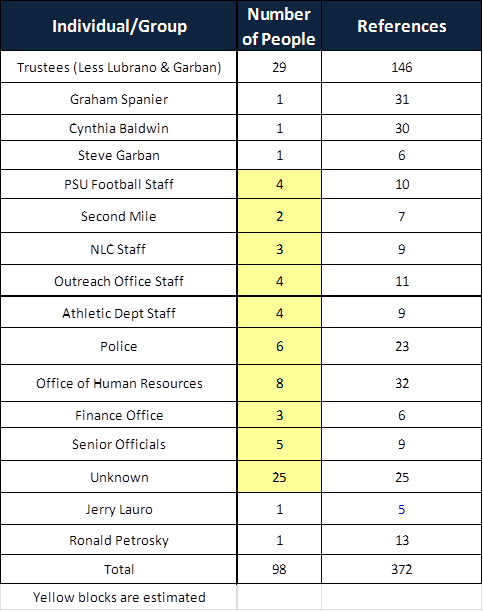
However, from the contents of the Freeh Report, we can determine that certain offices and people were asked specific things about procedures and processes under their purview. For example, the Outreach Office was asked about access to facilities. OHR was asked about the background check process. Ronald Petrosky's answers were specific to the incident that his co-worker, Jim Calhoun didn't witness and, of course, his immense fear of being fired by "President Paterno."
Conclusions
The Freeh Report's statement that 430 interviews were conducted may be true, however less than 430 were used in the report. The impression that 430 people were interviewed, often repeated by the media, is incorrect. As shown, it was more likely that 100 people or less were interviewed.Also, the sample is not representative, because the BOT makes up approximately 1/3 of the total of people interviewed and, of course, Louis Freeh was the BOT's client.
The determination that Paterno was in control of the football facilities and "knew everything that was going on" is not based on a legitimate analysis of comments.
Finally, I should also mention that the former VP for Student Affairs, Vicky Triponey, wasn't included as an end note, rather, she was a footnote. Someday, she won't even be that.


