Showing posts with label Consent Decree. Show all posts

Thursday, December 18

Analysis: Freeh Report Proved There Was No Basis for NCAA To Penalize PSU

The PSU BOT and NCAA must have believed...that PSU alumni were stupid enough to believe......that Erickson was stupid enough to believe.....that the NCAA had authority to impose the death penalty... based on the "plain language" of the Freeh Report. 


By
Ray Blehar

Over the past month, the media has quickly jumped on a few words or a passage from a deposition to draw conclusions about the NCAA's role in punishing PSU.  In most cases, the conclusions drawn have been incorrect, including the conclusion that PSU was bluffed by the NCAA and a later piece citing Rod Erickson's "out for blood" statements as proof that PSU was under duress. 

However, when reading and digesting all of the information available to date, the thing that sticks out most is that the "plain language" of the documents from this case defeat the "stories" being put forth by the defendants (and others, like former AG Linda Kelly).

Prior to the recent filings, the NCAA and PSU were both attempting to defend the legality/validity of the NCAA Consent Decree (CD).   As the Corman case has progressed, the co-defendants now have somewhat opposite agendas which must be considered when evaluating the truthfulness of their statements.    


PSU Agenda: Maintain duress scenario, Erickson's authority

PSU's agenda is to maintain the story that it signed the CD under threat of the death penalty, that Erickson had authority to sign for PSU, and that Erickson did the best that it could in light of the NCAA "being out for blood."  However, the depositions of Guadagnino and Erickson contained numerous inconsistencies and outright falsehoods that undermined their stories. 

Guadagnino (at 19) stated that he was hired as counsel for the Board in November 2011 -- which should give anyone pause about his qualifications -- considering the failure of all the lawyers involved to push back against the baseless charges against Curley and Schultz. 


He also stated (at 50) that in July, he and Dunham, with help from Paula Ammerman (!),   determined the President of PSU had the authority to sign the consent decree because nothing in PSU's rules prohibited him from doing so.  Erickson (at 125) also made that statement.  Those statements were patently false based on the "plain language" of the PSU BOT Standing Orders that were in effect in July 2012.  

Order IV. MATTERS REQUIRING APPROVAL OF THE BOARD OF TRUSTEES, 2. e.

"(e) Authorization to borrow money; authorization of persons to sign checks,contracts, legal documents, and other obligations, and to endorse, sell,or assign securities." 

Guadagnino and Dunham: Legal advice on
Erickson's authority influenced by Frazier?
There is no doubt that the the $60 million fine committed to by Erickson without a vote of the Board of Trustees was clearly a violation of this standing order.  Thus, the NCAA Consent Decree should be invalid because Erickson didn't have the authority to make an obligation of funds.   

The question in my mind is how did the  TWO lawyers come to the conclusion that Erickson had the authority to sign the Consent Decree?  My guess is they were told to come to that conclusion by former Merck Counsel and SITF co-lead Ken Frazier.


The NCAA's agenda: Maintain it was authorized to punish PSU

Erickson's "guilty plea" of LOIC
was all the NCAA had to go on.


The NCAA's agenda is to maintain that the NCAA Consent Decree is valid and that they had the authority to penalize PSU. However, after reading through the depositions of Don Remy, David Berst, Bob Williams, and Kevin Lennon, it became clear that the ONLY reason for the NCAA's decision to go forward with penalties against PSU was the "guilty plea" that was submitted by Rod Erickson. 

The deposition of Don Remy shows this most clearly, when he was asked if the NCAA accepted the Freeh Report.  He responded that they did not need to -- because Penn State did.   Really, what Erickson did in one fell swoop was to accept the Freeh Report and, most importantly, state to the NCAA the Freeh Report contained the evidence to support a Lack of Institutional Control  (LOIC).   

The "plain language" of its Constitution and By-Laws required violations of "applicable rules and regulations of the Association in the conduct of its intercollegiate athletics programs" for LOIC.  The NCAA knew there was no case -- and so did PSU.

Regardless of Erickson's admissions and willingness to enter into an agreement, the NCAA had no authority to uphold PSU's "guilty plea" of  LOIC or to penalize PSU.   The situation is analogous to a judge knowing that no crime was committed but accepting a guilty plea by the defendants' "attorney" (Erickson) -- all the while knowing the defendants (i.e. Curley and Schultz) were innocent.

Moreover, the NCAA's Julie Roe stated that it was doubtful that the penalties could have survived the enforcement (Committee on Infractions) process.  As I wrote here, even if the premature conclusion that there were ethical issues among the President, Head Coach, and/or Athletic Director at PSU, there were no NCAA rules violations resulting from the lack of ethics.  To make another analogy, if Spanier, Paterno, and Curley all turned out to be tax cheats, would the NCAA be authorized to punish the football program based on their dishonesty?  The answer is obviously, "no."

Those, like David Berst, who made the argument that their alleged lack of ethics/dishonesty enabled 14 years of despicable crimes being committed by Sandusky would, ironically, be proven wrong by the "plain language" of the Freeh Report.


Irony: "Plain Language" of Freeh Report Disproved LOIC

In the greatest irony in this case, the validity of three Freeh Report key findings cited in the CD were actually undermined by the contents of the Freeh Report.   In an equally interesting twist, no one had to do more than read to page 40 and leaf through the Exhibits to find the evidence that obliterated the so-called "factual basis" for the sanctions.  


These facts likely explain why there was such a rush by PSU to create a smokescreen of about the quality of the Freeh Report in an attempt to legitimize its findings.

Frazier:  “We thank Judge Freeh for his diligence in uncovering the facts over the past eight months and issuing such a comprehensive and thorough report.."

While the report was neither complete nor thorough, it had enough in it to disprove the key findings in its own Executive Summary, which were quoted in the CD.


Consent Decree Finding 1


Pages 20-30 of the Freeh Report specify crimes between 1998 and 2001, a span of four years -- not a decade.  No other crimes occurred on campus after 2001, according to the "plain language" of the Freeh Report (at 24 and 25).  


Next, there was no concealment of Sandusky's behaviors in 1998 nor in 2001.  

Freeh Report (at 20) clearly shows that the head of the University Park police department, a police detective, child welfare caseworker, and the local district attorney were all engaged on the case in 1998.


It is important to note that Sandusky was a full-time assistant coach with the football team during this fully reported and investigated incident in 1998.  The NCAA's assertion that the football program was unanswerable to oversight was nonsense.

In 2001, when Sandusky was a retired football coach, the Freeh Report (at 23) proved that head football coach Joe Paterno and graduate assistant coach, Mike McQueary, promptly reported Sandusky's activities to those in positions of power both inside (Curley) and outside (Schultz) the Athletic Department.  Additionally, Schultz sought legal advice on the matter from PSU's outside counsel Wendell Courtney.  


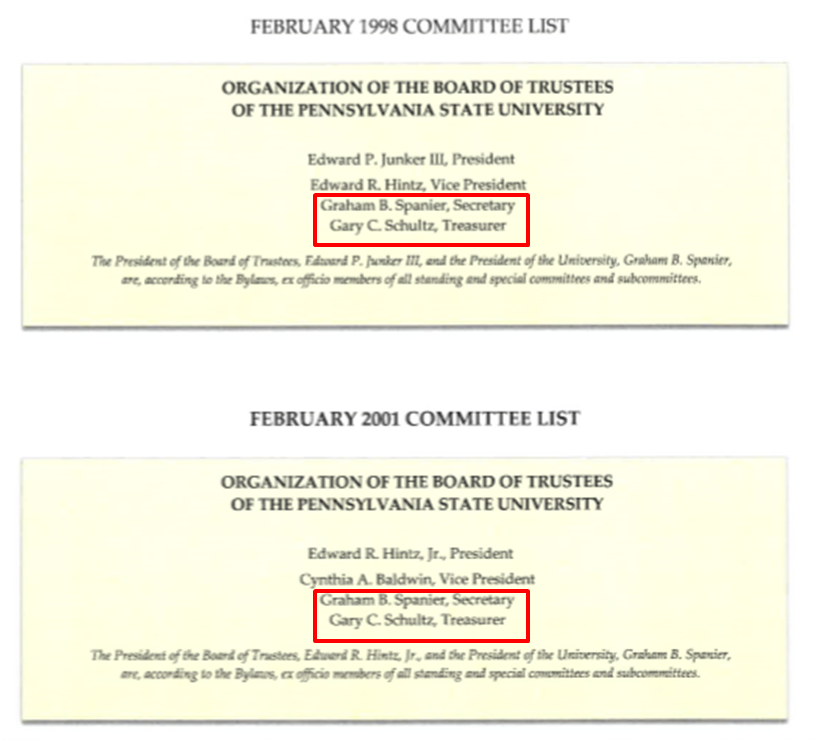
The charge of the football program concealing Sandusky activities from the Board of Trustees is also nonsense, given that Spanier and Schultz were members of the Board of Trustees (Freeh Report, Exhibit 10A).    


Emmert and NCAA officials ignored
the factual record in the Freeh Report
It truly boggles the mind that NCAA officials, such as Berst, Roe, and Emmert all stated that penalties should be levied from 1998 forward when the Freeh Report clearly showed PSU did everything correctly regarding the handling that incident.


This December 2012 exchange between Franco Harris and Mark Emmert reveals just how much  Emmert ignored the factual record in the Freeh Report.

Franco:  The report said in 1998 that Penn State was not involved in that.

Emmert: 
 Uh, uh, I read the report multiple times and I'm sure you have, and we'll have to agree to disagree.

Consent Decree Finding 2


The "plain language" in the Freeh Report (at 24) revealed that PSU Athletic Director Tim Curley instructed Sandusky not to use the facilities with children.  According to the trial verdicts in the case -- and the Freeh Report -- Sandusky did not use the facilities to commit crimes after 2001.


The "plain language" in the Freeh Report (at 36) also revealed that access to the University facilities for sports camps conducted by Sandusky and for the camps of The Second Mile were granted by PSU's Outreach and Cooperative Extension office -- not the Athletic Department.


Consent Decree Finding 3


Freeh Report Exhibit 6A proved that Spanier instructed PSU Counsel Baldwin to brief the Board regarding legal matters involved with the Sandusky investigation in April 2011.  That briefing was provided to the Board in May 2011, which was the first scheduled meeting after Spanier had been subpoenaed and testified in the Sandusky case.  Baldwin's briefing included information on the 1998, 2001, and the then-ongoing investigations of Sandusky.


As stated earlier, the 1998 investigation of Sandusky was handled in a confidential manner and resulted in no finding of abuse.  There was no reason for Spanier or anyone else to inform the Board about this incident as no one could have anticipated a legal action against PSU based on this isolated incident.


Similarly, the 2001 incident occurred when Sandusky was retired from PSU.  As a result, Sandusky's behavior was (at a minimum) reported to his employer (Freeh Report at 25).

Regardless of what Spanier or the Board did or didn't do, the Freeh Report (at 25) showed no  misconduct occurred within PSU's athletic facilities after 2001.  


No Rules Violations Reported In the Freeh Report

The Freeh Report provided no evidence of NCAA violations -- which are required to show that the alleged unethical and/or dishonesty of PSU officials resulted in a LOIC.  The Freeh Report mentions the NCAA just three times in the report at 37, at 38, and at 140, none of which address material deficiencies within the Athletic Department.

First, the report makes an unsupported claim that the Athletic Department's compliance function is understaffed.  Given that PSU had not had a major violation in its history (which the NCAA undoubtedly knew), what was the rationale for additional staffing?


The next reference to the NCAA in the Freeh Report (at 38) states that the University's independent auditing function  (Office of Internal Audit) conducted compliance audits with certain NCAA rules. Obviously, the OIA didn't find any rules violations according to the absence of findings in the Freeh Report.


The last mention of the NCAA in the Freeh Report (at 140) is within a "motherhood and apple pie" recommendation that PSU athletic department compliance officials and new hires should have a working knowledge of NCAA rules, among others. 


Remember, PSU paid Freeh $8.1 million for these types of recommendations and is currently paying George Mitchell about $1.8 million a year to monitor them.

This all begs the question, did anyone at the NCAA actually read the Freeh Report?

Who Really Read the Freeh Report?

It is quite likely that none of the key decision makers on the NCAA Executive Committee and Division I Board of Directors read more than the Executive Summary of the Freeh Report -- if that.  It may be just as likely that they didn't even do that.

Ed Ray's July 12th and 13th emails revealed that the reactions of the Head of the EC were based on media reports -- and not the Freeh Report.  On July 13th, he opined that "I think he has it right" with regard to Rick Reilly's ESPN article which also blamed PSU for the 1998 incident.  Note:  The op-ed by Reilly proved he was among those who didn't read the Freeh Report.


The July 13th email was written at 8:14 PM, which certainly gave Ed Ray time to read the Freeh Report.  However, I don't think Ed Ray spent one iota of time reading it, given his expectation that the NCAA was waiting for PSU's response to its November 17th letter.


The deposition of Bob Williams revealed he was reacting to Freeh's press conference comments and not the Freeh Report.   The word rape appears in the Freeh Report body just one time, on page 113, in a passage regarding the the crimes that fall under the Clery Act.  In addition, the Sandusky trial verdicts also revealed no incidents of rape on the PSU campus.    


David Berst's deposition revealed that he believed the Executive Committee were immediately voicing strong opinions on the matter based on details and was uncertain if they had read the Freeh Report or not.    


Conclusion

Ray: Head of the Executive Committee
or was he the Chief Rubber Stamper?
The lack of due diligence by the key decision makers at the NCAA -- to not make the effort to read the first 40 pages of the Freeh Report -- certainly gives one pause about their ability to be in any kind of leadership role.  Unfortunately, the NCAA EC is much like the "Old Guard" PSU BOT, which was referred to by many as the "country club."

It appears the EC was letting Mark Emmert and a small group run the show and they were simply a "rubber stamp" for that group's decisions.  

The facts of the case provides evidence that the NCAA Executives were the people guilty of violating (their own) NCAA rules by penalizing PSU and that the NCAA was the organization without adequate oversight -- not Penn State. 

Thursday, November 27

NCAA's Dishonesty in Penalizing PSU Should Be Its Downfall

Mark Emmert's lack of integrity and overreach by the NCAA in the PSU case makes the case for members to walk away.

By
Ray Blehar

"Penn State will be the death of Mark Emmert, that's my prediction."

                                                                                                                      -- Sonny Vaccaro, November 10th, 2014

When Sonny Vaccaro made that prediction at the Sports for Social Change conference at Drexel University, Mike Jensen of the Philadelphia Inquirer opined that Vaccaro didn't sugar coat his opinions because he was in the state of Pennsylvania and the conference had an anti-NCAA feel.

I disagree.  

Vaccaro didn't sugar coat his opinions because the facts are on his side.  Even with just a partial set of facts, the NCAA has been subject to harsh criticism for its alleged "bluff" of PSU and abandoning its primary purposes.


When questioned by the Senate about why the NCAA should exist, Emmert stated that the problems and issues that made recent headlines were confined to big-time sports, which only makes up 5% of the NCAA. He pointed to the lack of problems in non-revenue sports as evidence  that the NCAA was effective 95% of the time.  

Of course, his answer was nonsense.  The only difference is less media attention is focused on violations (and crimes) that occur in non-revenue sports.

Ironically, one of the key players in the PSU case, Wally Renfro, said upon retiring that NCAA member schools are an aggregation, but whether they decide to be aggregated under the NCAA or another body is up to them.  As the Power Five conferences have been given some autonomy to govern themselves, the writing is on the wall that the days are numbered for the governing body of collegiate athletics. 

While those closely following the case understand that the entire PSU case is based on falsehoods, when the media finally wakes up to that fact,  the PSU case should be Emmert's and the NCAA's Waterloo.

The NCAA Failures in the PSU Case

What is most disturbing about the PSU case is that the NCAA accepted PSU's "plea" of a Lack Of Institutional Control (LOIC) all the while knowing there was no evidence or underlying violations to make that case.

On November 17th, 2011, the NCAA's letter to PSU cited numerous by-laws in forcing its way into the Sandusky matter.  A fair reading of the cited By-Laws (i.e., 2.1,  2.4,  6.01.1,  6.04,  10.1, 10.01.1,  11.1.1,  11.1.2.1, and 19.01.2)  reveals that NCAA rules or by-laws violations must exist that emanated from a lack of integrity, honesty, or values.  

In other words, illegal benefits, a competitive advantage, unsportsmanlike conduct, or an environment that negatively influenced student athletes must be present for the NCAA to make its case for a LOIC.

The NCAA simply didn't have the evidence to make that case and apparently had no idea that the claims they made to support penalizing PSU were ridiculous in light of the facts.


Athletics Integrity Agreement, Scholarships, Bowl Ban


Even considering the fact that Sandusky was convicted of numerous crimes in June 2012, there is no evidence to support that he was anything but a positive role model for the student athletes under his tutelage when he coached at PSU and in the years leading up to the criminal charges against him.  In fact, much of Pennsylvania and former President Bush recognized Sandusky for his volunteer efforts making a difference in the community at-large.  

In addition, there is no evidence to support that Joe Paterno was anything but a positive role model for the student athletes he coached.  Even more, Paterno embodied the values which the NCAA alleges is at its core -- the education and well being of student athletes.  

PSU's stellar graduation rates for the football team and its student athletes overall, as well as the fact that the University has never had a major NCAA violation, was proof that the institution was doing things the right way and had been doing so for a long time.

In January 2011, NCAA President Mark Emmert presented the Gerald R. Ford Award to Paterno at the NCAA Convention. The award honors an individual who has provided significant leadership as an advocate for intercollegiate athletics on a continuous basis throughout his or her career. "For me, Coach Paterno is the definitive role model of what it means to be a college coach," said Emmert.


Mitchell's monitoring: an act of fraud?
The idea that PSU would need an Athletics Integrity Agreement was ridiculous in 2012 and it's just as ridiculous today.  Moreover, the NCAA's hiring of George Mitchell to monitor PSU's progress was nothing more than an act of fraud.  

Apparently the NCAA hired Mitchell because of his former work in the Major League Baseball steroid scandal. Mitchell's report was not without controversy, specifically with regard to conflicts of interest.

It should come as no surprise to Penn Staters that Mitchell had nothing to say about the PSU BOT's revised conflict of interest policy (which permits conflicts of interest) and that he failed to highlight Board lies about completing all 119 Freeh Report recommendations.  In fact, the first recommendation from the Freeh Report, 1.1 Culture, is not only incomplete, but doesn't pass the "giggle test" in terms of current governance at PSU.  The current majority of the board has no accountability and its recent decisions have been anything but ethical or values-based.


However, according to former Senator Mitchell, the "culture" that put football above values of human decency made such progress in one year that the scholarships were partially restored.  And in just two years, the alleged "culture problem" was apparently resolved because all of the scholarships were restored and the bowl ban was lifted.

The only penalties still remaining against PSU are vacating the football program's wins from 1998 through 2011 (which was really a penalty against Paterno, not the school) and the $60 million fine (which wasn't justified according to the Sandusky crimes timeline).


Competitive Advantage - Vacation of Wins


As the July 14 and 15, 2012 emails revealed, Julie Roe (Lach), Kevin Lennon, and Wally Renfro all appeared to agree that even if PSU was guilty of not reporting Sandusky's crimes, the University did not gain a competitive advantage.  Roe pointed to PSU's 2012 recruiting class as evidence that the current scandal didn't have an impact on recruiting.

When it came time to write the press release about the eventual PSU sanctions, Roe was singing a very different, factually deficient, tune.


First, the idea that wins were based on a pristine image is quite a stretch. Apparently, the University of Toledo didn't get the message in 2000 when they beat PSU by a score of 24-6.  In fact, the Toledo score -- among 37 others -- makes up the corroborating evidence that Roe was full of crap.

The 1998 recruiting class was in place when PSU first reported Sandusky to authorities.  Authorities cleared Sandusky, therefore there was no possibility of bad publicity given the confidential nature of child abuse investigations.  However, let's go with Roe's illogical thesis and verify the "great success on the field" gained by "competitive advantage" (as a result of child welfare officials clearing Sandusky in 1998).

The 1999 recruiting class had a four year record of 29-20 (59.2%).

In March 2001, PSU officials similarly reported Sandusky's conduct to a licensed child care professional from The Second Mile, Dr. Jack Raykovitz.  After he consulted with other TSM Board members, they determined Sandusky's showering with children was a "non-starter."

The 2002 recruiting class had a four year record of 27-21 (59.2%)

Roe's contention that PSU had great success isn't even backed up by the football program's on-field performance.  The combined record for the years in question was 47-37 or 56.9%.  

Since the NCAA purports to be an organization that promotes education, it should know that 56.9% was a solid "F" (but better than the graduation rates for student athletes at LSU when Emmert was chancellor there).  

PSU was far from enjoying "great success" in the years following the Sandusky incidents on campus and a simple check of the record books would have proven that.

The lack of due diligence and outright lying by the NCAA in this case was simply breathtaking.

$60 Million Fine to Support Child Welfare Programs

While many point to this fine as one of the few positive things resulting from the NCAA's actions in the case, there is no evidence to justify why PSU should pay this penalty.


McQueary's testimony about the 2001 incident
didn't convince a jury that a rape occurred.
The Sandusky trial resulted in guilty charges in 45 of 48 counts. The most incendiary charge, which undoubtedly put the focus on PSU, was that McQueary witnessed a boy being "subjected to anal intercourse by a naked Sandusky."  As the trial verdicts proved, there was insufficient evidence to support that charge. 

All of the not guilty verdicts at the trial appeared to be related to charges that were trumped up by the prosecutors.  It's not a coincidence that those allegations were about incidents on the PSU campus, given that the OAG was trying to build a case against Spanier.

Taking a page from Sara Ganim,  the trial verdicts confirmed Sandusky did not anally rape anyone on PSU's campus.  In addition, they revealed that no crimes occurred on PSU's campus after 2001 and that no crimes occurred for a period of years after PSU officials intervened. 

These facts contradict the NCAA Consent Decree statement (lifted from the Freeh Report) that PSU officials "failed to protect against a child predator harming children for over a decade."   PSU's intervention appeared to offer protection for a few years -- before Sandusky offended again.  The facts also show that PSU's intervention in 2001 was more effective than that of Pennsylvania's child welfare caseworkers in 1998.

According to Ken Singer of Male Survivor.

"I've worked with offenders who have recidivated after a number of years," Singer said. "It's not that the desires or the impulses are not there but the degree of control, which could be anything from a spouse keeping a good watch on him that keeps him from acting on impulse, it could be disgust with self and promises not to do this again, but then they hit a situation where they go back to other behavior." 

Singer compared offender behavior to that of an alcoholic. 

"It's similar to an alcoholic that has been drinking for years then stops because of internal conditions, he's sick of drinking or whatever, finds sobriety, goes to AA, doesn't drink again for a number of years but then falls off the wagon and resumes his former lifestyle," Singer said. 


Louis Freeh's press conference remarks that "the rapes of those boys occurred in the Lasch building" and that Sandusky's misconduct continued on campus through 2011 were also false, based on the trial verdicts.  Freeh's report was an abject failure in educating the public about offenders like Sandusky and that failure was perpetuated by opinions held and remarks made by NCAA officials.

NCAA officials, including the Executive Committee and the Division I, II, and III Boards, appeared to react to media soundbites and didn't seem to be the least bit aware of the Sandusky trial verdicts or that the PSU officials charged had yet to have their day in court. 

David Berst (in his deposition at 137) was quite surprised that University Presidents on the Executive Committee had such strong opinions on the case.

"Well, I think what I was thinking at the time was that I have, you know, processed about 2,000 infractions cases in serious matters, and there are lots of sides to every issue.  And it seemed interesting to me that there was such interest in heading in that  direction or framing their comments in that manner without reviewing all of the information that was available.   I don't know whether they had read the Freeh Report at that point or just were reacting to some of the details.  But the  reactions were surprising to me." 

 It surely seemed that NCAA public relations chief, Bob Williams, based his opinions on Freeh's press conference remarks -- not on the facts of the case.


However, what is truly hypocritical about the NCAA's punishment of the $60 million fine and blaming PSU for Sandusky's abuse is that Mark Emmert stated in November 2011 that he would never blame this type of problem on athletics and (rightly) viewed it as a societal issue.


What happened in the eight months from Emmert's assertion that he would never blame athletics to the Consent Decree, which fully laid the Sandusky crimes on "King Football?"

Suppressed Evidence Undermines Consent Decree

Emmert & Nifong ignored exculpatory evidence to
press flimsy cases at PSU and Duke, respectively
To make an analogy, Mark Emmert behaved much like DA Mike Nifong in the Duke case. Like Nifong, Emmert had "DNA evidence" proving the accused were innocent, but persisted in pursuing the case because of the positive publicity it would generate for the NCAA.

According to documentary evidence in the case, the NCAA learned that PSU Athletic Department's compliance staff was "fastidious on rules violations."  In other words, the very thing needed to make a case for LOIC was missing.

But that's not all that was missing. 

Erickson:  Complicit in the cover up of
 information about the 2001 incident
In January 2012, PSU President Rod Erickson was informed that Mike McQueary gave a "benign description" of the shower incident when he reported it in 2001.  The documents go on to state that McQueary, when interviewed by "detectives - 10 years later" provided a "more vivid (description) than before."
  
The Freeh Report didn't contain this information, even though Freeh stated all witnesses, with a few exceptions, were cooperative.

 It appears that some witnesses - top PSU officials, like Erickson - withheld evidence from Freeh (or Freeh colluded by not including that evidence).

Whatever the case, the so-called "contract" known as the NCAA Consent Decree was entered into under the false pretense that the Freeh Report justified "fashioning an appropriate remedy for the violations."  


Conclusion

There is not smoking gun evidence that PSU shared (exculpatory) evidence about PSU officials' lack of knowledge of the 2001 incident details with the NCAA.  However, the evidence to date is stacking up to show that PSU kept the NCAA informed of developments surrounding the OAG investigation of Spanier, Curley, and Schultz.

In November 2011, Mark Emmert stated that the NCAA's practice was to wait for criminal investigations to conclude before conducting an inquiry.  In the PSU case, the NCAA was involved, at least tangentially, with an ongoing criminal investigation.


Then Emmert contradicted himself by moving to penalize PSU before the criminal cases of Curley, Schultz, and Spanier had concluded.  Emmert (and the media) prematurely concluded the men were guilty based on the outcome of a "privatized justice system"  run by former FBI director Louis Freeh.  By doing so, the NCAA violated its own process, and worse yet, its harsh penalties and over-the-top rhetoric defied its own core values of organization. 

In closing, the NCAA not only endangered the safety of student athletes on the PSU football team who were now put at a competitive disadvantage, but it demeaned an institution that had always been the role model for combining athletic and academic excellence.

For those reasons, Mark Emmert needs to go and the NCAA needs to go with him.


Saturday, September 13

Emmert and the NCAA's Hypocrisy About Education and Protecting Children

For two years in a row, the NCAA's hypocrisy on its value of education and protecting children reared its head when it commented on the reductions to Penn State's sanctions.

By
Ray Blehar

If you give Mark Emmert a chance to speak, the chances are he will say something that exposes himself as a hypocrite.  That's probably why he didn't comment on the recent NCAA sanction reductions at Penn State.  However, let's turn back the clock and examine what Emmert had to say after the sanctions were reduced last fall.

"From the beginning, the goal of the Penn State sanctions and the Athletics Integrity Agreement has been to ensure that the university reinforces clear expectations and a daily mindset within athletics that the highest priority has to be placed on educating, nurturing and protecting young people, and to recognize the impact of the abuse on the lives of the victims in this case."


NCAA: Should be renamed
Not Credible Athletic Association
Rather than a statement from Emmert this year, the NCAA had its Executive Committee speak on its behalf and -- to no one's surprise -- they delivered the same hypocrisy as last year. 


“Penn State has made remarkable progress over the past year,” said Harris Pastides, Board member and University of South Carolina president. “The board members and I believe the Executive Committee’s decision is the right one. It allows both the university and the association to continue to move toward a common goal of ensuring that educating, nurturing and protecting young people is a top priority.”

While there is little doubt that Penn State athletics is on board with educating young people,  as it has been for over 50 years, I don't believe you can say the same for the NCAA or Mark Emmert.

Education

Mark Emmert's criticism of Penn State for not putting a priority on education was the height of hypocrisy.  One only need to look at the academic records of the football team when he was chancellor at Louisiana State University and his own commentary to understand that Emmert had a low bar when it came to academic success.


Recruiting Class Year              LSU                                     Penn State
1999                                        37%                                         76%
2000                                        38%                                         72%
2001                                        37%                                         75%
2002                                        42%                                         80%
2003                                        42%                                         77%
2004                                        48%                                         80%


Emmert's assessment of LSU's performance:

"The facts speak for themselves.  We went from an athletic program that was underperforming dramatically in the classroom to one that was performing well."

Having less than 50% of student-athletes graduate for six consecutive years isn't performing well and the so-called improvement, if graded academically, would mean that LSU didn't move up a grade and stayed solidly at an F-. 

The NCAA also had less than a shining moment with regard to 2011-2012 academic scandal at the University of North Carolina  -- and it appears that a "do over" is underway.  


Martin's Investigation concluded
academic fraud, lack of oversight
After the original inquiry, an NCAA enforcement staff member stated there were"no violations of current NCAA rules or student-athlete eligibility issues related to courses in African and Afro-American Studies."   However, UNC Chancellor Carol Folt admitted that "they failed the kids" and former basketball player Rashad McCants also gave a first person account of the academic fraud.  

Former faculty member Julius Nyang'oro was charged with felony criminal fraud for his role in the scandal.  He has since cut a deal and had the charges dropped in exchange for his cooperation with the Wainstein investigation.

Finally, Governor Jim Martin's 2012 investigation said that it was clearly "an academic scandal" and not an athletic scandal.  This was based on extensive analysis of courses that showed that both student-athletes and regular students were enrolled in the anomalous courses, had similar numbers of unauthorized grade changes, and similar grade point averages. Martin's  investigation resulted in 120 changes to ensure the problems didn't recur. 

 The bottom line, however, is that both the student-athletes and the non-student-athletes were not being educated, rather they were receiving course credits.

That point strikes at the heart of the Core Values of the  NCAA, which includes:

The collegiate model of athletics in which students participate as an avocation, balancing their academic, social and athletics experiences.

The pursuit of excellence in both academics and athletics.


What was the "academic experience" gained in those anomalous courses?  Where was the excellence in academics? 

Obviously, there was none and the NCAA was fine with student-athletes that violated the organization's core values so long as they didn't violate eligibility rules.
  

Child Protection
On July 23, 2012, the NCAA entered into the Consent Decree with Penn State.  The Consent Decree described Penn State, Joe Paterno, its employees, and the University community in the harshest of terms.  It held that Penn State's alleged failures in the Sandusky scandal violated core principles of human decency, morality, and honesty. 

Among the punitive features of the agreement was to be $60 million in fines to be paid to the NCAA to be placed in an endowment for programs for preventing child sexual abuse or to assist victims of child sexual abuse.  

Senator Jake Corman (later joined by Rob McCord) filed a lawsuit against the NCAA to prevent the $60 million in fines from being spent outside Pennsylvania's borders.  The NCAA had set up a task force to decide how to spend the money, which determined that 25% would be spent in Pennsylvania.  Corman's lawsuit stated the NCAA's plan violated the Pennsylvania Constitution.

As the case made its way through the legal system, with the NCAA losing at every turn, the organization finally dropped its opposition to the Corman lawsuit on the same day it reduced the sanctions that emanated from the Consent Decree.   The motion to dismiss must be ruled on by Judge Anne Covey.

It was little coincidence that the Mitchell report was released on September 8, 2014 because that so happened to be the day that Judge Covey ruled that all discovery was to be completed.  If you had any doubts that the NCAA, Penn State, and Mitchell were pulling a scam before last Monday, this should erase them.

NCAA and Mark Emmert
Hypocrisy is par for the course.
Rather than a Friday news dump, as they did in the UNC case in 2012, the NCAA chose to use a different tactic to avoid bad publicity.  Withdrawing from the lawsuit on the same day as the sanction reductions were announced severely reduced attention on the NCAA's latest legal set back.  As you might expect, few in the national media covered the news about the lawsuit.  

For an organization that decried Penn State for valuing football over the welfare of children, look who used "football news" to avoid even more damage to its already tarnished reputation.  

The hypocrisy is overwhelming -- yet, expected from Mark Emmert and the NCAA.

For more hypocrisy, here is the NCAA's statement on it's withdrawal from the lawsuit (courtesy of StateCollege.com):

 "Continuing this litigation would have further delayed the distribution of the funds to sexual abuse survivors for years, undermining the very intent of the fine. Our legal case is strong, but we believe even more strongly in preventing child sexual abuse and aiding survivors."

How much does the NCAA really believe in preventing child sexual abuse?  

When the Freeh Report conclusions about Sandusky's sexual abuse of children were blown up by former FBI profiler, James Clemente, the NCAA had no comment.   

Clemente stated that Freeh relied on the "common, yet erroneous stereotype of child sex offenders" and that his report "interpreted the facts using the wrong filter."   The tragic result of the Freeh Report is that it did not alert the public to the more insidious "acquaintance offender" who goes undetected for many years and abuses many children.  

The NCAA chose to stand behind the erroneous Freeh Report and stay silent, rather than to inform the public about threats that every child may face.   This action or lack thereof, exposes the NCAA's hypocrisy in its statement about preventing child sexual abuse.


Conclusion

Despite the levying of a $60 million dollar fine, the NCAA's actions in the Penn State case have been little more than a publicity stunt in an attempt to reverse its reputation as a weak enforcement organization.  Subsequent actions have shown the Penn State case to be both a mistake and an anomaly.  The NCAA has gone back to being a weak enforcer (see Miami (FL) case) and Emmert remains little more than empty suit.

While the public still awaits the trials of PSU officials for their alleged concealment of Sandusky's crimes and other charges, the verdict appears to be in on the NCAA....

Given the choice, the NCAA chosen to conceal information about its dealings with Penn State, Freeh, Mitchell, and the PA OAG, rather than fight to maintain its plans for aiding in the protection of the nation's children.