| ||||
|

Showing posts with label Curley. Show all posts
Showing posts with label Curley. Show all posts
Saturday, April 30
PS4RS 4/29/2016 Statement: AG Not Pursuing Appeal


Friday, January 22
PS4RS Press Statement on PA Superior Court Ruling
PRESS STATEMENT (my emphasis added)
PA Superior Court Ruling Upends Case Against Penn State Admins
January 22, 2016 —— Members of Penn Staters for Responsible Stewardship are pleased with today’s ruling by the Superior Court of Pennsylvania resulting in the dismissal of multiple charges against Penn State administrators. The ruling dismisses the charges of perjury, obstruction of justice and conspiracy against Penn State administrators Tim Curley, Gary Schultz and Graham Spanier. But we are not finished. All we have asked since November 2011 is for due process for everyone involved. Unfortunately, the Penn State Board of Trustees, their hired gun Louis Freeh, and the opportunistic NCAA all ignored the concept that is the very foundation of our country. Each rushed to judgment and in the process impugned loyal, respectable, generous and -- most of all -- innocent men. The court overturned the despicable violation of these men’s constitutional rights by the Office of the Attorney General in collusion with former Penn State trustee and Counsel Cynthia Baldwin. Their actions have cost the state's flagship university hundreds of millions of dollars and caused untold anguish for hundreds of thousands of Penn State alumni and supporters.
It is a travesty that Jerry Sandusky and his use of The Second Mile to prey on at-risk children was not identified sooner by the Pennsylvania Department of Public Welfare. It is inexcusable that he was not promptly indicted by then-Attorney General Tom Corbett and his deputy, Frank Fina. As we have contended from Day One, this was never a Penn State problem. It was – and still very much is -- a state of Pennsylvania problem.
Penn Staters for Responsible Stewardship (PS4RS), with more than 40,000 members nationwide, was formed to promote positive change within the University Board of Trustees, demanding transparent, trustworthy leadership. For further information on PS4RS, please visitwww.PS4RS.org, email ps4rsinfo@ps4rs.org, or go tohttp://www.facebook.com/PS4RS. Follow PS4RS on Twitter at @PS4RS
Friday, August 28
"Nifonged" Part 2: The Real Conspiracy of Silence
According to the Moulton Report, "the Penn State state emails" were turned over by July 7, 2011, proving a key obstruction of justice allegation was false and that Fina suppressed this evidence to charge Curley and Schultz with failure to report.
By
Ray Blehar
In Part 1 of the series, the evidence indicated that Frank Fina's expectation that Curley and Schultz would "flip" was among the reasons behind his use of unreliable evidence. Fina's reliance in pressing charges on flimsy evidence was much worse than that of Durham DA Mike Nifong, who was eventually disbarred over his misconduct in the Duke lacrosse case. In Part 2, the Moulton Report and a lot of other evidence reveal the misconduct on the part of Fina and then-Penn State Counsel Cynthia Baldwin during the Sandusky investigation -- in the lead up to the eventual Conspiracy of Silence case.
On November 1, 2012, the Conspiracy of Silence (CoS) presentment levied allegations of obstruction justice against Graham Spanier, Gary Schultz, and Tim Curley. While a long list of allegations were included in the presentment, many of which were not crimes, the key allegation of obstruction of justice was the lack of compliance with Subpoena 1179.
GJ Subpoena 1179 (Sandusky case), issued on December 29, 2010 requested:
"Any and all records pertaining to Jerry Sandusky and incidents reported to have occurred on or about March 2002, and any other information concerning Jerry Sandusky and inappropriate contact with underage males both on and off University property. Response shall include any and all correspondence directed to or regarding Jerry Sandusky."
"July 7, 2011. Tpr. Rossman receives a thumb drive containing Penn State emails."
Trooper Scott Rossman and OAG Agent Anthony Sassano were the two investigators assigned to the case in July 2011. Obviously, Rossman's receipt of the Penn State emails proves the charge of a "total lack of compliance" was false.
Additionally, the notebook of former PSU President Rodney Erickson appears to confirm that Penn State had Schultz's notes by at least January 31, 2012 -- a little under a year before the obstruction charges were filed.

The analysis performed by Eileen Morgan made a very strong case that Penn State provided the OAG with the Schultz file in early January 2011 and that Fina utilized it in the grand jury examinations of Curley and Schultz.
However, the falsity of the obstruction charges doesn't stop there. Not by a long-shot.
Smoke and Mirrors
PSU Policy AD49, effective July 19, 2010, clearly states that the General Counsel (Baldwin) was responsible for answering subpoenas:
All legal documents including subpoenas are to be referred to or routed through The Office of General Counsel. The Office has the prerogative to send them to other parties after receipt. The Office of General Counsel shall establish all procedures for handling and addressing legal documents."
The entire obstruction of justice and criminal conspiracy ruse is based on the assumption that Baldwin followed through on her responsibilities.
Baldwin's grand jury testimony (pages 16-21) was clear that she met with each man one-on-one to discuss the subpoena.
The evidence tells a different story.
Baldwin not only stonewalled the PSU Three about the subpoena, but of all of her knowledge of the evidence relevant to the Sandusky case.
"LEGAL DOCUMENTS INCLUDING SUBPOENAS:
 |
| Baldwin "stonewalled" the PSU Three |
The entire obstruction of justice and criminal conspiracy ruse is based on the assumption that Baldwin followed through on her responsibilities.
Baldwin's grand jury testimony (pages 16-21) was clear that she met with each man one-on-one to discuss the subpoena.
Baldwin not only stonewalled the PSU Three about the subpoena, but of all of her knowledge of the evidence relevant to the Sandusky case.
The Baldwin Stonewall
1998 Incident: According to the Freeh Report (page 83), Baldwin obtained a copy of the 1998 police report on January 4, 2011. Based on the consistent lack of recall of the 1998 incident by Paterno, Curley, and Schultz, it is quite obvious she didn't share the report to help prepare them for their appearance. Similarly, Spanier recalled almost nothing about the 1998 incident when he appeared at the grand jury in April 2011.
2002 Incident: Subpoena 1179 clearly identified 2002 as the date of the McQueary incident, but when under questioning at their pre-grand jury interviews, neither Curley nor Schultz got the date correct. Curley guessed 2000, while Schultz believed the incident was in 2003. At Spanier's April 2011 grand jury appearance, he correctly stated 2002, although he said he wasn't sure of the date, but recalled it was about three years after Sandusky retired.
Subpoena 1179: Baldwin did not advise Penn State officials of their responsibility to search for materials relevant to the subpoena.
Curley: According to Curley's omnibus pre-trial motion, he twice met with Baldwin, once at the Outback Bowl in Tampa, Florida (prior to the issuance of the subpoena) and once in State College, Pennsylvania to discuss his appearance at the grand jury. Curley's motion makes no mention that Baldwin advised him to search for materials responsive to the subpoena.
Paterno: Scott Paterno, son of legendary coach, Joe Paterno, stated that Baldwin resisted providing him with his father's subpoena to testify and didn't provide it until April 2011. He also stated that Baldwin never asked his father to search for any documents. The Paterno family later volunteered numerous documents regarding Sandusky to assist in the Freeh investigation.
Schultz: According to Schultz's omnibus pretrial motion, in December 2010, Baldwin informed him that he was subpoenaed to testify before the grand jury in January 2011. Schultz agreed to let Baldwin accept service of the subpoena on his behalf. Schultz's affidavit made no mention of Baldwin informing him to search for Sandusky related materials.
"In that period from January, February, March, she [Baldwin] only gave me a report that these folks are going to the grand jury. She told me somewhere along the way that they were interviewing staff in the football program, and she would be there for all the interviews. But she never told me what was asked about in the interviews, never told me what came up with Curley and Gary Schultz in their testimony."
Motions To Quash: Baldwin never filed a motion to quash the Subpoena 1179 nor did she make any other formal appeal to the OAG for relief. As such, the OAG was likely expecting many documents to be produced.
According to the presentment, PSU had only turned over a handful of documents prior to the testimony of Curley, Schultz, and Paterno.

In consideration of the evidence above, Baldwin was either a completely incompetent attorney or she was intentionally undercutting PSU officials. The circumstances of her hiring appears to point to the latter.
But what do Baldwin's follies have to do with Frank Fina?
Unwitting Targets
During the January 2011 grand jury, Sandusky case prosecutors Eshbach and Fina didn't ask Curley, Schultz, and Paterno if they were informed about Subpoena 1179 or if they conducted searches to find relevant information. |
| Fina: No questions about Subpoena 1179 |
Based on the evidence, it is almost certain that the Commonwealth knew Baldwin had not informed Curley, Schultz, and Paterno about their responsibilities to gather information in response to Subpoena 1179.
This is not a case about a bunch of incompetent lawyers, but more likely a case of Fina, Eshbach, and Baldwin collaborating to extract sworn testimony from Penn State officials who had no idea they were targets of the Sandusky investigation.
More Lies About Emails
Page 23 of the presentment alleges that Penn State did not use its established procedures or personnel to conduct the searches for emails. The allegations (below) are false, as # 3 and #4 were disproved by the testimony of Penn State employee, John Corro, who works for Security Operations and Services (SOS).
On July 29, 2013, Corro testified (on page 89 and 90) that in April 2011, he recovered the emails based on the searches for Curley, Schultz, and Spanier, then provided them to Baldwin (page 91).
Corro further elaborated (pages 91 and 92) that he provided three USB keys to Baldwin, one which contained the entire set of emails and two that were of specific searches.

When asked if he saw Subpoena 1179, like the others, Corro stated had not. He had only seen a few lines of it as part of another document, but understood that he was searching for information related to the Sandusky investigation.

According to the agreement made at the Spanier GJ colloquy on April 13, 2011, Penn State was ordered to provide the entire history of emails from PSU officials dating back the University's implementation of email (i.e., prior to 1997) for Spanier, Curley, Schultz, and Paterno.
Due to the system cut-over in 2004, the search for emails responsive to Subpoena 1179 (citing 2002) required Penn State to access the archived files where Gary Schultz's 1998 and 2001 email files were located. Corro didn't testify to any issues with accessing the archived files.
Penn State was to provide the full set - everything found - to the grand jury judge and then a "culled set" specifically related to Sandusky to the OAG.
Baldwin agreed to provide everything by April 15, 2011.
No evidence to date identifies the exact date on which Baldwin provided the USB keys to the grand jury judge and/or the OAG, however, the testimony of Corro, and statements by Fina and Eshbach reveal that all of the 1998 and 2001 the emails were in the OAG's possession by April 2011.
As for Louis Freeh's alleged discovery of the 1998 and 2001 emails...the evidence reveals that it didn't happen.
Summary of Evidence
The bottom line is that Fina, et al, knew that Penn State had indeed used the SOS to gather materials responsive to Subpoena 1179 and that Spanier, Curley, and Schultz were not guilty of obstructing the investigation by failing to turn over information. To wit:1. Schultz was retired from Penn State when Subpoena 1179 was served and had no access to the Sandusky file in his old office or to his 1998 and 2001 (archived) emails. According to an affidavit filed by Schultz, he informed Baldwin of the possible existence of the Sandusky file. Any failure to provide those materials was because of Baldwin, not Schultz.
2. Spanier did not possess materials responsive to the subpoena.
3. There has been no evidence provided to date, aside from a reference in Erickson's notebook, that Curley possessed any evidence responsive to the subpoena.
The only other conspiracy to obstruct justice charge is wholly dependent upon the Commonwealth's legally impossible task of proving that Mike McQueary informed Curley and Schultz that a crime was being committed.
In other words, the Commonwealth has nothing.
And let's face it, if there was any material/inculpatory evidence to be found, Louie Freeh would have put in his report.
Fina vs. Nifong
One of the reasons Durham County DA Mike Nifong was disbarred was for failure to disclose evidence that negated the guilt of the defendants. Nifong failed to provide the complete results of the DNA tests that concluded two of the three defendants were not involved in the alleged rape of Crystal Mangum and made numerous misrepresentations about the nature of the evidence before the court. The withholding of evidence was in violation of former Rule 3.8(d) of the Revised Rules of Professional Conduct. The misrepresentations were in violation of Rule 8.4 (c).Fina's case is a bit different than Nifong's, however the same rules of conduct apply.
The fact that the Penn State emails were in the Commonwealth's possession by at least July 2011 (if not April 2011) is proof that the Commonwealth knowingly lied about Penn State's failure to comply with Subpoena 1179.
Given that the emails (and the Schultz file) included the date of the 2001 incident witnessed by McQueary, the evidence also proves that Fina, et al, purposely misstated the year of the McQueary incident in order to charge Curley and Schultz with failure to report in November 2011.
The Sandusky prosecution team of Fina and Eshbach filed numerous documents with the court misrepresenting the date of the Victim 2 incident as March 1, 2002. It was not until May 7, 2012 that Fina and McGettigan's Motion to Amend the Bill of Particulars to provided the correct date of February 9, 2001.
The evidence shows that Fina, et al, made numerous misrepresentations to the court during the Sandusky proceedings, in initially charging Curley and Schultz, and during Baldwin's grand jury testimony in October 2012.
Conclusion
The evidence regarding Penn State's provision of the email evidence is exactly the type of information that Frank Fina and his cohorts likely feared would be exposed when their "flip" strategy failed.While Moulton's investigation didn't highlight it, there is little doubt that his investigative team uncovered the email ruse. If not for the toxic politics of the Sandusky case -- and the pre-emptive strike by Fina -- AG Kane might have already went public about Fina's deception.
No doubt, there was a "conspiracy of silence" related to the Sandusky case, but not by the people accused of it.
Next: Freeh "Fail"
Tuesday, March 10
Analysis: Evidence Rules Out PSU Cover-Up in 2001
Police and OAG investigators interviewed 67 former and/or current Centre County CYS employees -- but none were presented as grand jury witnesses regarding the 2001 case. That is one of many pieces of evidence that demonstrate the weakness of the Commonwealth's case.
Evidence For
1. Mike McQueary testified that he conveyed to PSU officials "that it was a in a very bad sexual act, a molestation act with a minor"
2. Under the 2007 law, Curley, Schultz, and Spanier were required to report the incident to the authorities because they were "school employees."
3. No records exist to verify that Penn State made a report of the incident in 2001.
4. An unauthenticated email covering the period on February 25-27, 2001, suggests (but not conclusively) that a report was not made to child welfare authorities in 2001.
5. Former University Park police chief Tom Harmon was the only witness (with first hand knowledge) to testify that no report was made to the police about the 2001 incident.
Evidence Against
McQueary's Report
1. McQueary testified that he did not use any explicitly sexual language with any of the PSU officials and, in fact, said he could not remember the exact words he used. McQueary testified that the men "definitely received from me that it was sexual." (July 29, 2013 hearing, page 29)
2. There are not corroborating witnesses for McQueary's statements to Curley and Schultz.
3. Other individuals who McQueary informed about the incident on February 9th, 2001 did not advise him to make a report to the police and/or child welfare. Those individuals also did not make a report.
The Law
4. Under the child abuse reporting statute in 2001, no Penn State officials were among the enumerated individuals who were mandated to report child abuse.
5. The statute's definition of a student (under section 6303) was "[a]n individual enrolled in a public or private school, intermediate unit or area vocational-technical school who is under 18 years of age." The statute did not apply to colleges and universities in 2001.
Child Abuse Reports/Records
6. Under Pennsylvania law, there is no requirement for reporters of child abuse to maintain a record of the report.
7. In 2001, local child welfare authorities were not required to report General Protective Services complaints to the State-wide database. Note: Required to be included as of July 1, 2014.
8. Under the Public Welfare Code provision for General Protective Services, local child welfare authorities have the discretion to prioritize and investigate complaints based on a risk assessment of the alleged abuse report.
9. Centre County Children and Youth Services (CC CYS) assisted in the 1998 investigation of Sandusky and was aware the investigation did not result in an abuse finding.
10. Records of investigations of unfounded complaints are expunged upon notification by ChildLine.
History of Penn State's Reports of Sandusky's Behavior
13. There is no evidence that PSU officials were aware of any inappropriate conduct by Sandusky with children after February 9, 2001.
14. PSU officials openly communicated about the 1998 and 2001 incidents over email and courtesy copied support staff on some of the communications.
15. PSU Senior Vice-President of Business and Finance, Gary Schultz, reported his knowledge of the 2001 incident to the University's legal counsel, Wendell Courtney.
16. According to the grand jury presentment and other court proceedings, Schultz recalled that a report of the 2001 incident was made to local child welfare authorities (i.e., CC CYS).
17. According to an email (page 84 of Freeh Report) from Wendell Courtney, he recalled that in 2001 "someone...contacted Children and Youth Services to advise of the situation."
Lack of Corroborating Witnesses/Witness Credibility
18. According to the Moulton Report (page 156), the Director of CC CYS testified at the Sandusky grand jury on March 10, 2011, however her testimony did not address the 2001 incident.
19. According to the Moulton Report's timeline (pages 142 to 166) none of the 66 former and/or current employees of CC CYS interviewed by the police and/or general investigators were presented as grand jury witnesses about the 2001 incident.
20. Prosecution witness, former University Park police chief Tom Harmon testified that he purposely mislabeled the 1998 police report of the Sandusky investigation so that the press would not be able to discover it in the police logs.
21. The University Park police under Harmon's direction had no qualms about arresting football players and properly reporting the arrests as such in the police logs.
22. Harmon was formerly a neighbor of Sandusky's and attended the same church.
23. Harmon was a mandated reporter of child abuse in 2001 and he could have been charged with failure to report child abuse if he admitted knowledge of the 2001 incident.
24. On the Monday after the incident, Harmon emailed Schultz to confirm that a report of the 1998 incident existed in the imaged archives. Harmon testified that Schultz didn't ask him about the file nor did he recall giving the file to Schultz.
The numbers don't lie.
There is reasonable doubt at every turn (without introducing more doubt based on the actions an inactions of The Second Mile).
Note: This is a companion post, titled "What Are They Hiding?" that will examine the possible reasons why Commonwealth officials and the Board of Trustees pinned the blame on PSU officials for enabling Sandusky's crimes.
By
Ray Blehar
The existing media scenario and the view of law enforcement is one and the same -- PSU officials conspired to cover-up Sandusky's crimes to protect the school's and the football program's reputation.
The evidence, however, tells a very different story.
When the evidence for and against a cover-up is weighed, the evidence stacks up heavily against the existing/accepted scenario.
The evidence, however, tells a very different story.
When the evidence for and against a cover-up is weighed, the evidence stacks up heavily against the existing/accepted scenario.
Evidence For
1. Mike McQueary testified that he conveyed to PSU officials "that it was a in a very bad sexual act, a molestation act with a minor"
2. Under the 2007 law, Curley, Schultz, and Spanier were required to report the incident to the authorities because they were "school employees."
3. No records exist to verify that Penn State made a report of the incident in 2001.
4. An unauthenticated email covering the period on February 25-27, 2001, suggests (but not conclusively) that a report was not made to child welfare authorities in 2001.
5. Former University Park police chief Tom Harmon was the only witness (with first hand knowledge) to testify that no report was made to the police about the 2001 incident.
Evidence Against
McQueary's Report
1. McQueary testified that he did not use any explicitly sexual language with any of the PSU officials and, in fact, said he could not remember the exact words he used. McQueary testified that the men "definitely received from me that it was sexual." (July 29, 2013 hearing, page 29)
2. There are not corroborating witnesses for McQueary's statements to Curley and Schultz.
3. Other individuals who McQueary informed about the incident on February 9th, 2001 did not advise him to make a report to the police and/or child welfare. Those individuals also did not make a report.
The Law
4. Under the child abuse reporting statute in 2001, no Penn State officials were among the enumerated individuals who were mandated to report child abuse.
5. The statute's definition of a student (under section 6303) was "[a]n individual enrolled in a public or private school, intermediate unit or area vocational-technical school who is under 18 years of age." The statute did not apply to colleges and universities in 2001.
Child Abuse Reports/Records
6. Under Pennsylvania law, there is no requirement for reporters of child abuse to maintain a record of the report.
7. In 2001, local child welfare authorities were not required to report General Protective Services complaints to the State-wide database. Note: Required to be included as of July 1, 2014.
8. Under the Public Welfare Code provision for General Protective Services, local child welfare authorities have the discretion to prioritize and investigate complaints based on a risk assessment of the alleged abuse report.
9. Centre County Children and Youth Services (CC CYS) assisted in the 1998 investigation of Sandusky and was aware the investigation did not result in an abuse finding.
10. Records of investigations of unfounded complaints are expunged upon notification by ChildLine.
History of Penn State's Reports of Sandusky's Behavior
11. PSU cooperated fully with a 1998 investigation of then active assistant football coach, Jerry Sandusky.
12. In 2001, PSU Athletic Director Timothy Curley reported (then-retired) Sandusky's shower incident outside of the University his employer, The Second Mile.13. There is no evidence that PSU officials were aware of any inappropriate conduct by Sandusky with children after February 9, 2001.
14. PSU officials openly communicated about the 1998 and 2001 incidents over email and courtesy copied support staff on some of the communications.
15. PSU Senior Vice-President of Business and Finance, Gary Schultz, reported his knowledge of the 2001 incident to the University's legal counsel, Wendell Courtney.
16. According to the grand jury presentment and other court proceedings, Schultz recalled that a report of the 2001 incident was made to local child welfare authorities (i.e., CC CYS).
17. According to an email (page 84 of Freeh Report) from Wendell Courtney, he recalled that in 2001 "someone...contacted Children and Youth Services to advise of the situation."
Lack of Corroborating Witnesses/Witness Credibility
18. According to the Moulton Report (page 156), the Director of CC CYS testified at the Sandusky grand jury on March 10, 2011, however her testimony did not address the 2001 incident.
19. According to the Moulton Report's timeline (pages 142 to 166) none of the 66 former and/or current employees of CC CYS interviewed by the police and/or general investigators were presented as grand jury witnesses about the 2001 incident.
20. Prosecution witness, former University Park police chief Tom Harmon testified that he purposely mislabeled the 1998 police report of the Sandusky investigation so that the press would not be able to discover it in the police logs.
21. The University Park police under Harmon's direction had no qualms about arresting football players and properly reporting the arrests as such in the police logs.
22. Harmon was formerly a neighbor of Sandusky's and attended the same church.
23. Harmon was a mandated reporter of child abuse in 2001 and he could have been charged with failure to report child abuse if he admitted knowledge of the 2001 incident.
24. On the Monday after the incident, Harmon emailed Schultz to confirm that a report of the 1998 incident existed in the imaged archives. Harmon testified that Schultz didn't ask him about the file nor did he recall giving the file to Schultz.
The numbers don't lie.
Conclusion
Based on the evidence on the public record to date, it will be extremely difficult, if not impossible, for the Commonwealth to meet the standard of proof beyond a reasonable doubt for its allegation of a failure to report and a cover-up by PSU officials.There is reasonable doubt at every turn (without introducing more doubt based on the actions an inactions of The Second Mile).
Note: This is a companion post, titled "What Are They Hiding?" that will examine the possible reasons why Commonwealth officials and the Board of Trustees pinned the blame on PSU officials for enabling Sandusky's crimes.
Thursday, December 18
Analysis: Freeh Report Proved There Was No Basis for NCAA To Penalize PSU
The PSU BOT and NCAA must have believed...that PSU alumni were stupid enough to believe......that Erickson was stupid enough to believe.....that the NCAA had authority to impose the death penalty... based on the "plain language" of the Freeh Report.
By
Ray Blehar
Over the past month, the media has quickly jumped on a few words or a passage from a deposition to draw conclusions about the NCAA's role in punishing PSU. In most cases, the conclusions drawn have been incorrect, including the conclusion that PSU was bluffed by the NCAA and a later piece citing Rod Erickson's "out for blood" statements as proof that PSU was under duress.
However, when reading and digesting all of the information available to date, the thing that sticks out most is that the "plain language" of the documents from this case defeat the "stories" being put forth by the defendants (and others, like former AG Linda Kelly).
Prior to the recent filings, the NCAA and PSU were both attempting to defend the legality/validity of the NCAA Consent Decree (CD). As the Corman case has progressed, the co-defendants now have somewhat opposite agendas which must be considered when evaluating the truthfulness of their statements.
Guadagnino (at 19) stated that he was hired as counsel for the Board in November 2011 -- which should give anyone pause about his qualifications -- considering the failure of all the lawyers involved to push back against the baseless charges against Curley and Schultz.
He also stated (at 50) that in July, he and Dunham, with help from Paula Ammerman (!), determined the President of PSU had the authority to sign the consent decree because nothing in PSU's rules prohibited him from doing so. Erickson (at 125) also made that statement. Those statements were patently false based on the "plain language" of the PSU BOT Standing Orders that were in effect in July 2012.
Order IV. MATTERS REQUIRING APPROVAL OF THE BOARD OF TRUSTEES, 2. e.
"(e) Authorization to borrow money; authorization of persons to sign checks,contracts, legal documents, and other obligations, and to endorse, sell,or assign securities."
There is no doubt that the the $60 million fine committed to by Erickson without a vote of the Board of Trustees was clearly a violation of this standing order. Thus, the NCAA Consent Decree should be invalid because Erickson didn't have the authority to make an obligation of funds.
The question in my mind is how did the TWO lawyers come to the conclusion that Erickson had the authority to sign the Consent Decree? My guess is they were told to come to that conclusion by former Merck Counsel and SITF co-lead Ken Frazier.
The NCAA's agenda is to maintain that the NCAA Consent Decree is valid and that they had the authority to penalize PSU. However, after reading through the depositions of Don Remy, David Berst, Bob Williams, and Kevin Lennon, it became clear that the ONLY reason for the NCAA's decision to go forward with penalties against PSU was the "guilty plea" that was submitted by Rod Erickson.
The deposition of Don Remy shows this most clearly, when he was asked if the NCAA accepted the Freeh Report. He responded that they did not need to -- because Penn State did. Really, what Erickson did in one fell swoop was to accept the Freeh Report and, most importantly, state to the NCAA the Freeh Report contained the evidence to support a Lack of Institutional Control (LOIC).
The "plain language" of its Constitution and By-Laws required violations of "applicable rules and regulations of the Association in the conduct of its intercollegiate athletics programs" for LOIC. The NCAA knew there was no case -- and so did PSU.
Regardless of Erickson's admissions and willingness to enter into an agreement, the NCAA had no authority to uphold PSU's "guilty plea" of LOIC or to penalize PSU. The situation is analogous to a judge knowing that no crime was committed but accepting a guilty plea by the defendants' "attorney" (Erickson) -- all the while knowing the defendants (i.e. Curley and Schultz) were innocent.
Moreover, the NCAA's Julie Roe stated that it was doubtful that the penalties could have survived the enforcement (Committee on Infractions) process. As I wrote here, even if the premature conclusion that there were ethical issues among the President, Head Coach, and/or Athletic Director at PSU, there were no NCAA rules violations resulting from the lack of ethics. To make another analogy, if Spanier, Paterno, and Curley all turned out to be tax cheats, would the NCAA be authorized to punish the football program based on their dishonesty? The answer is obviously, "no."
Those, like David Berst, who made the argument that their alleged lack of ethics/dishonesty enabled 14 years of despicable crimes being committed by Sandusky would, ironically, be proven wrong by the "plain language" of the Freeh Report.
These facts likely explain why there was such a rush by PSU to create a smokescreen of about the quality of the Freeh Report in an attempt to legitimize its findings.
Frazier: “We thank Judge Freeh for his diligence in uncovering the facts over the past eight months and issuing such a comprehensive and thorough report.."
While the report was neither complete nor thorough, it had enough in it to disprove the key findings in its own Executive Summary, which were quoted in the CD.



Freeh Report Exhibit 6A proved that Spanier instructed PSU Counsel Baldwin to brief the Board regarding legal matters involved with the Sandusky investigation in April 2011. That briefing was provided to the Board in May 2011, which was the first scheduled meeting after Spanier had been subpoenaed and testified in the Sandusky case. Baldwin's briefing included information on the 1998, 2001, and the then-ongoing investigations of Sandusky.


As stated earlier, the 1998 investigation of Sandusky was handled in a confidential manner and resulted in no finding of abuse. There was no reason for Spanier or anyone else to inform the Board about this incident as no one could have anticipated a legal action against PSU based on this isolated incident.
Similarly, the 2001 incident occurred when Sandusky was retired from PSU. As a result, Sandusky's behavior was (at a minimum) reported to his employer (Freeh Report at 25).
Regardless of what Spanier or the Board did or didn't do, the Freeh Report (at 25) showed no misconduct occurred within PSU's athletic facilities after 2001.
First, the report makes an unsupported claim that the Athletic Department's compliance function is understaffed. Given that PSU had not had a major violation in its history (which the NCAA undoubtedly knew), what was the rationale for additional staffing?
 The next reference to the NCAA in the Freeh Report (at 38) states that the University's independent auditing function (Office of Internal Audit) conducted compliance audits with certain NCAA rules. Obviously, the OIA didn't find any rules violations according to the absence of findings in the Freeh Report.

The last mention of the NCAA in the Freeh Report (at 140) is within a "motherhood and apple pie" recommendation that PSU athletic department compliance officials and new hires should have a working knowledge of NCAA rules, among others.

Remember, PSU paid Freeh $8.1 million for these types of recommendations and is currently paying George Mitchell about $1.8 million a year to monitor them.
This all begs the question, did anyone at the NCAA actually read the Freeh Report?
Ed Ray's July 12th and 13th emails revealed that the reactions of the Head of the EC were based on media reports -- and not the Freeh Report. On July 13th, he opined that "I think he has it right" with regard to Rick Reilly's ESPN article which also blamed PSU for the 1998 incident. Note: The op-ed by Reilly proved he was among those who didn't read the Freeh Report.

The July 13th email was written at 8:14 PM, which certainly gave Ed Ray time to read the Freeh Report. However, I don't think Ed Ray spent one iota of time reading it, given his expectation that the NCAA was waiting for PSU's response to its November 17th letter.

The deposition of Bob Williams revealed he was reacting to Freeh's press conference comments and not the Freeh Report. The word rape appears in the Freeh Report body just one time, on page 113, in a passage regarding the the crimes that fall under the Clery Act. In addition, the Sandusky trial verdicts also revealed no incidents of rape on the PSU campus.

David Berst's deposition revealed that he believed the Executive Committee were immediately voicing strong opinions on the matter based on details and was uncertain if they had read the Freeh Report or not.

The lack of due diligence by the key decision makers at the NCAA -- to not make the effort to read the first 40 pages of the Freeh Report -- certainly gives one pause about their ability to be in any kind of leadership role. Unfortunately, the NCAA EC is much like the "Old Guard" PSU BOT, which was referred to by many as the "country club."
It appears the EC was letting Mark Emmert and a small group run the show and they were simply a "rubber stamp" for that group's decisions.
The facts of the case provides evidence that the NCAA Executives were the people guilty of violating (their own) NCAA rules by penalizing PSU and that the NCAA was the organization without adequate oversight -- not Penn State.
By
Ray Blehar
Over the past month, the media has quickly jumped on a few words or a passage from a deposition to draw conclusions about the NCAA's role in punishing PSU. In most cases, the conclusions drawn have been incorrect, including the conclusion that PSU was bluffed by the NCAA and a later piece citing Rod Erickson's "out for blood" statements as proof that PSU was under duress.
However, when reading and digesting all of the information available to date, the thing that sticks out most is that the "plain language" of the documents from this case defeat the "stories" being put forth by the defendants (and others, like former AG Linda Kelly).
Prior to the recent filings, the NCAA and PSU were both attempting to defend the legality/validity of the NCAA Consent Decree (CD). As the Corman case has progressed, the co-defendants now have somewhat opposite agendas which must be considered when evaluating the truthfulness of their statements.
PSU Agenda: Maintain duress scenario, Erickson's authority
PSU's agenda is to maintain the story that it signed the CD under threat of the death penalty, that Erickson had authority to sign for PSU, and that Erickson did the best that it could in light of the NCAA "being out for blood." However, the depositions of Guadagnino and Erickson contained numerous inconsistencies and outright falsehoods that undermined their stories.Guadagnino (at 19) stated that he was hired as counsel for the Board in November 2011 -- which should give anyone pause about his qualifications -- considering the failure of all the lawyers involved to push back against the baseless charges against Curley and Schultz.
He also stated (at 50) that in July, he and Dunham, with help from Paula Ammerman (!), determined the President of PSU had the authority to sign the consent decree because nothing in PSU's rules prohibited him from doing so. Erickson (at 125) also made that statement. Those statements were patently false based on the "plain language" of the PSU BOT Standing Orders that were in effect in July 2012.
Order IV. MATTERS REQUIRING APPROVAL OF THE BOARD OF TRUSTEES, 2. e.
"(e) Authorization to borrow money; authorization of persons to sign checks,contracts, legal documents, and other obligations, and to endorse, sell,or assign securities."
 |
| Guadagnino and Dunham: Legal advice on Erickson's authority influenced by Frazier? |
The question in my mind is how did the TWO lawyers come to the conclusion that Erickson had the authority to sign the Consent Decree? My guess is they were told to come to that conclusion by former Merck Counsel and SITF co-lead Ken Frazier.
The NCAA's agenda: Maintain it was authorized to punish PSU
 |
| Erickson's "guilty plea" of LOIC was all the NCAA had to go on. |
The deposition of Don Remy shows this most clearly, when he was asked if the NCAA accepted the Freeh Report. He responded that they did not need to -- because Penn State did. Really, what Erickson did in one fell swoop was to accept the Freeh Report and, most importantly, state to the NCAA the Freeh Report contained the evidence to support a Lack of Institutional Control (LOIC).
The "plain language" of its Constitution and By-Laws required violations of "applicable rules and regulations of the Association in the conduct of its intercollegiate athletics programs" for LOIC. The NCAA knew there was no case -- and so did PSU.
Regardless of Erickson's admissions and willingness to enter into an agreement, the NCAA had no authority to uphold PSU's "guilty plea" of LOIC or to penalize PSU. The situation is analogous to a judge knowing that no crime was committed but accepting a guilty plea by the defendants' "attorney" (Erickson) -- all the while knowing the defendants (i.e. Curley and Schultz) were innocent.
Moreover, the NCAA's Julie Roe stated that it was doubtful that the penalties could have survived the enforcement (Committee on Infractions) process. As I wrote here, even if the premature conclusion that there were ethical issues among the President, Head Coach, and/or Athletic Director at PSU, there were no NCAA rules violations resulting from the lack of ethics. To make another analogy, if Spanier, Paterno, and Curley all turned out to be tax cheats, would the NCAA be authorized to punish the football program based on their dishonesty? The answer is obviously, "no."
Those, like David Berst, who made the argument that their alleged lack of ethics/dishonesty enabled 14 years of despicable crimes being committed by Sandusky would, ironically, be proven wrong by the "plain language" of the Freeh Report.
Irony: "Plain Language" of Freeh Report Disproved LOIC
In the greatest irony in this case, the validity of three Freeh Report key findings cited in the CD were actually undermined by the contents of the Freeh Report. In an equally interesting twist, no one had to do more than read to page 40 and leaf through the Exhibits to find the evidence that obliterated the so-called "factual basis" for the sanctions.These facts likely explain why there was such a rush by PSU to create a smokescreen of about the quality of the Freeh Report in an attempt to legitimize its findings.
Frazier: “We thank Judge Freeh for his diligence in uncovering the facts over the past eight months and issuing such a comprehensive and thorough report.."
While the report was neither complete nor thorough, it had enough in it to disprove the key findings in its own Executive Summary, which were quoted in the CD.
Consent Decree Finding 1
Pages 20-30 of the Freeh Report specify crimes between 1998 and 2001, a span of four years -- not a decade. No other crimes occurred on campus after 2001, according to the "plain language" of the Freeh Report (at 24 and 25).

Next, there was no concealment of Sandusky's behaviors in 1998 nor in 2001.
Freeh Report (at 20) clearly shows that the head of the University Park police department, a police detective, child welfare caseworker, and the local district attorney were all engaged on the case in 1998.

It is important to note that Sandusky was a full-time assistant coach with the football team during this fully reported and investigated incident in 1998. The NCAA's assertion that the football program was unanswerable to oversight was nonsense.
In 2001, when Sandusky was a retired football coach, the Freeh Report (at 23) proved that head football coach Joe Paterno and graduate assistant coach, Mike McQueary, promptly reported Sandusky's activities to those in positions of power both inside (Curley) and outside (Schultz) the Athletic Department. Additionally, Schultz sought legal advice on the matter from PSU's outside counsel Wendell Courtney.

Next, there was no concealment of Sandusky's behaviors in 1998 nor in 2001.
Freeh Report (at 20) clearly shows that the head of the University Park police department, a police detective, child welfare caseworker, and the local district attorney were all engaged on the case in 1998.
It is important to note that Sandusky was a full-time assistant coach with the football team during this fully reported and investigated incident in 1998. The NCAA's assertion that the football program was unanswerable to oversight was nonsense.
In 2001, when Sandusky was a retired football coach, the Freeh Report (at 23) proved that head football coach Joe Paterno and graduate assistant coach, Mike McQueary, promptly reported Sandusky's activities to those in positions of power both inside (Curley) and outside (Schultz) the Athletic Department. Additionally, Schultz sought legal advice on the matter from PSU's outside counsel Wendell Courtney.
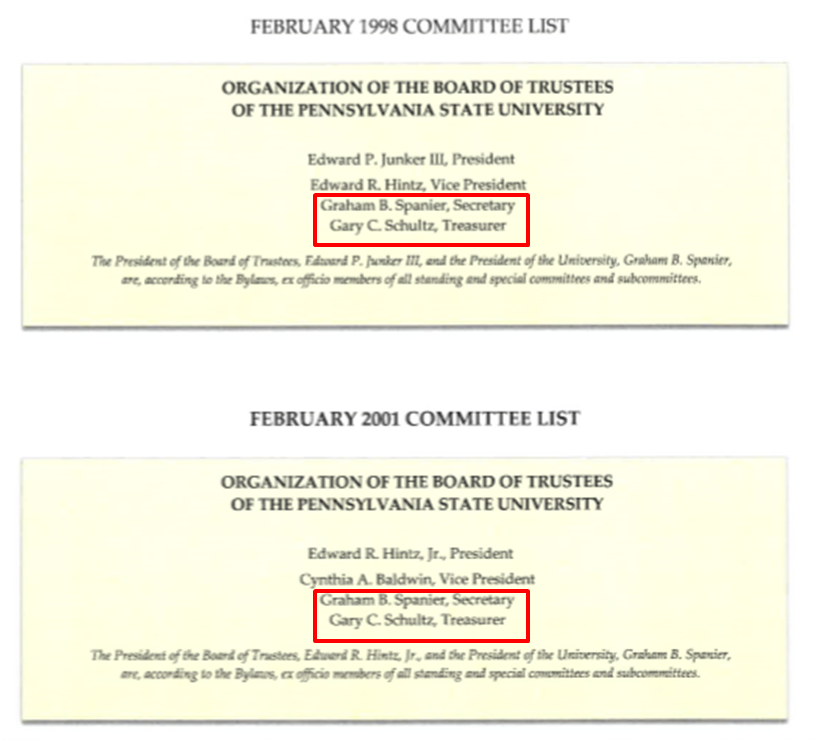
The charge of the football program concealing Sandusky activities from the Board of Trustees is also nonsense, given that Spanier and Schultz were members of the Board of Trustees (Freeh Report, Exhibit 10A).
 |
| Emmert and NCAA officials ignored the factual record in the Freeh Report |
It truly boggles the mind that NCAA officials, such as Berst, Roe, and Emmert all stated that penalties should be levied from 1998 forward when the Freeh Report clearly showed PSU did everything correctly regarding the handling that incident.
This December 2012 exchange between Franco Harris and Mark Emmert reveals just how much Emmert ignored the factual record in the Freeh Report.
Franco: The report said in 1998 that Penn State was not involved in that.
Emmert: Uh, uh, I read the report multiple times and I'm sure you have, and we'll have to agree to disagree.
Emmert: Uh, uh, I read the report multiple times and I'm sure you have, and we'll have to agree to disagree.
Consent Decree Finding 2
The "plain language" in the Freeh Report (at 24) revealed that PSU Athletic Director Tim Curley instructed Sandusky not to use the facilities with children. According to the trial verdicts in the case -- and the Freeh Report -- Sandusky did not use the facilities to commit crimes after 2001.
The "plain language" in the Freeh Report (at 36) also revealed that access to the University facilities for sports camps conducted by Sandusky and for the camps of The Second Mile were granted by PSU's Outreach and Cooperative Extension office -- not the Athletic Department.
Consent Decree Finding 3
Freeh Report Exhibit 6A proved that Spanier instructed PSU Counsel Baldwin to brief the Board regarding legal matters involved with the Sandusky investigation in April 2011. That briefing was provided to the Board in May 2011, which was the first scheduled meeting after Spanier had been subpoenaed and testified in the Sandusky case. Baldwin's briefing included information on the 1998, 2001, and the then-ongoing investigations of Sandusky.
As stated earlier, the 1998 investigation of Sandusky was handled in a confidential manner and resulted in no finding of abuse. There was no reason for Spanier or anyone else to inform the Board about this incident as no one could have anticipated a legal action against PSU based on this isolated incident.
Similarly, the 2001 incident occurred when Sandusky was retired from PSU. As a result, Sandusky's behavior was (at a minimum) reported to his employer (Freeh Report at 25).
Regardless of what Spanier or the Board did or didn't do, the Freeh Report (at 25) showed no misconduct occurred within PSU's athletic facilities after 2001.
No Rules Violations Reported In the Freeh Report
The Freeh Report provided no evidence of NCAA violations -- which are required to show that the alleged unethical and/or dishonesty of PSU officials resulted in a LOIC. The Freeh Report mentions the NCAA just three times in the report at 37, at 38, and at 140, none of which address material deficiencies within the Athletic Department.First, the report makes an unsupported claim that the Athletic Department's compliance function is understaffed. Given that PSU had not had a major violation in its history (which the NCAA undoubtedly knew), what was the rationale for additional staffing?
The last mention of the NCAA in the Freeh Report (at 140) is within a "motherhood and apple pie" recommendation that PSU athletic department compliance officials and new hires should have a working knowledge of NCAA rules, among others.
Remember, PSU paid Freeh $8.1 million for these types of recommendations and is currently paying George Mitchell about $1.8 million a year to monitor them.
This all begs the question, did anyone at the NCAA actually read the Freeh Report?
Who Really Read the Freeh Report?
It is quite likely that none of the key decision makers on the NCAA Executive Committee and Division I Board of Directors read more than the Executive Summary of the Freeh Report -- if that. It may be just as likely that they didn't even do that.Ed Ray's July 12th and 13th emails revealed that the reactions of the Head of the EC were based on media reports -- and not the Freeh Report. On July 13th, he opined that "I think he has it right" with regard to Rick Reilly's ESPN article which also blamed PSU for the 1998 incident. Note: The op-ed by Reilly proved he was among those who didn't read the Freeh Report.
The July 13th email was written at 8:14 PM, which certainly gave Ed Ray time to read the Freeh Report. However, I don't think Ed Ray spent one iota of time reading it, given his expectation that the NCAA was waiting for PSU's response to its November 17th letter.
The deposition of Bob Williams revealed he was reacting to Freeh's press conference comments and not the Freeh Report. The word rape appears in the Freeh Report body just one time, on page 113, in a passage regarding the the crimes that fall under the Clery Act. In addition, the Sandusky trial verdicts also revealed no incidents of rape on the PSU campus.
David Berst's deposition revealed that he believed the Executive Committee were immediately voicing strong opinions on the matter based on details and was uncertain if they had read the Freeh Report or not.
Conclusion
 |
| Ray: Head of the Executive Committee or was he the Chief Rubber Stamper? |
It appears the EC was letting Mark Emmert and a small group run the show and they were simply a "rubber stamp" for that group's decisions.
The facts of the case provides evidence that the NCAA Executives were the people guilty of violating (their own) NCAA rules by penalizing PSU and that the NCAA was the organization without adequate oversight -- not Penn State.
Subscribe to:
Posts (Atom)
