Showing posts with label Ray. Show all posts

Thursday, December 18

Analysis: Freeh Report Proved There Was No Basis for NCAA To Penalize PSU

The PSU BOT and NCAA must have believed...that PSU alumni were stupid enough to believe......that Erickson was stupid enough to believe.....that the NCAA had authority to impose the death penalty... based on the "plain language" of the Freeh Report. 


By
Ray Blehar

Over the past month, the media has quickly jumped on a few words or a passage from a deposition to draw conclusions about the NCAA's role in punishing PSU.  In most cases, the conclusions drawn have been incorrect, including the conclusion that PSU was bluffed by the NCAA and a later piece citing Rod Erickson's "out for blood" statements as proof that PSU was under duress. 

However, when reading and digesting all of the information available to date, the thing that sticks out most is that the "plain language" of the documents from this case defeat the "stories" being put forth by the defendants (and others, like former AG Linda Kelly).

Prior to the recent filings, the NCAA and PSU were both attempting to defend the legality/validity of the NCAA Consent Decree (CD).   As the Corman case has progressed, the co-defendants now have somewhat opposite agendas which must be considered when evaluating the truthfulness of their statements.    


PSU Agenda: Maintain duress scenario, Erickson's authority

PSU's agenda is to maintain the story that it signed the CD under threat of the death penalty, that Erickson had authority to sign for PSU, and that Erickson did the best that it could in light of the NCAA "being out for blood."  However, the depositions of Guadagnino and Erickson contained numerous inconsistencies and outright falsehoods that undermined their stories. 

Guadagnino (at 19) stated that he was hired as counsel for the Board in November 2011 -- which should give anyone pause about his qualifications -- considering the failure of all the lawyers involved to push back against the baseless charges against Curley and Schultz. 


He also stated (at 50) that in July, he and Dunham, with help from Paula Ammerman (!),   determined the President of PSU had the authority to sign the consent decree because nothing in PSU's rules prohibited him from doing so.  Erickson (at 125) also made that statement.  Those statements were patently false based on the "plain language" of the PSU BOT Standing Orders that were in effect in July 2012.  

Order IV. MATTERS REQUIRING APPROVAL OF THE BOARD OF TRUSTEES, 2. e.

"(e) Authorization to borrow money; authorization of persons to sign checks,contracts, legal documents, and other obligations, and to endorse, sell,or assign securities." 

Guadagnino and Dunham: Legal advice on
Erickson's authority influenced by Frazier?
There is no doubt that the the $60 million fine committed to by Erickson without a vote of the Board of Trustees was clearly a violation of this standing order.  Thus, the NCAA Consent Decree should be invalid because Erickson didn't have the authority to make an obligation of funds.   

The question in my mind is how did the  TWO lawyers come to the conclusion that Erickson had the authority to sign the Consent Decree?  My guess is they were told to come to that conclusion by former Merck Counsel and SITF co-lead Ken Frazier.


The NCAA's agenda: Maintain it was authorized to punish PSU

Erickson's "guilty plea" of LOIC
was all the NCAA had to go on.


The NCAA's agenda is to maintain that the NCAA Consent Decree is valid and that they had the authority to penalize PSU. However, after reading through the depositions of Don Remy, David Berst, Bob Williams, and Kevin Lennon, it became clear that the ONLY reason for the NCAA's decision to go forward with penalties against PSU was the "guilty plea" that was submitted by Rod Erickson. 

The deposition of Don Remy shows this most clearly, when he was asked if the NCAA accepted the Freeh Report.  He responded that they did not need to -- because Penn State did.   Really, what Erickson did in one fell swoop was to accept the Freeh Report and, most importantly, state to the NCAA the Freeh Report contained the evidence to support a Lack of Institutional Control  (LOIC).   

The "plain language" of its Constitution and By-Laws required violations of "applicable rules and regulations of the Association in the conduct of its intercollegiate athletics programs" for LOIC.  The NCAA knew there was no case -- and so did PSU.

Regardless of Erickson's admissions and willingness to enter into an agreement, the NCAA had no authority to uphold PSU's "guilty plea" of  LOIC or to penalize PSU.   The situation is analogous to a judge knowing that no crime was committed but accepting a guilty plea by the defendants' "attorney" (Erickson) -- all the while knowing the defendants (i.e. Curley and Schultz) were innocent.

Moreover, the NCAA's Julie Roe stated that it was doubtful that the penalties could have survived the enforcement (Committee on Infractions) process.  As I wrote here, even if the premature conclusion that there were ethical issues among the President, Head Coach, and/or Athletic Director at PSU, there were no NCAA rules violations resulting from the lack of ethics.  To make another analogy, if Spanier, Paterno, and Curley all turned out to be tax cheats, would the NCAA be authorized to punish the football program based on their dishonesty?  The answer is obviously, "no."

Those, like David Berst, who made the argument that their alleged lack of ethics/dishonesty enabled 14 years of despicable crimes being committed by Sandusky would, ironically, be proven wrong by the "plain language" of the Freeh Report.


Irony: "Plain Language" of Freeh Report Disproved LOIC

In the greatest irony in this case, the validity of three Freeh Report key findings cited in the CD were actually undermined by the contents of the Freeh Report.   In an equally interesting twist, no one had to do more than read to page 40 and leaf through the Exhibits to find the evidence that obliterated the so-called "factual basis" for the sanctions.  


These facts likely explain why there was such a rush by PSU to create a smokescreen of about the quality of the Freeh Report in an attempt to legitimize its findings.

Frazier:  “We thank Judge Freeh for his diligence in uncovering the facts over the past eight months and issuing such a comprehensive and thorough report.."

While the report was neither complete nor thorough, it had enough in it to disprove the key findings in its own Executive Summary, which were quoted in the CD.


Consent Decree Finding 1


Pages 20-30 of the Freeh Report specify crimes between 1998 and 2001, a span of four years -- not a decade.  No other crimes occurred on campus after 2001, according to the "plain language" of the Freeh Report (at 24 and 25).  


Next, there was no concealment of Sandusky's behaviors in 1998 nor in 2001.  

Freeh Report (at 20) clearly shows that the head of the University Park police department, a police detective, child welfare caseworker, and the local district attorney were all engaged on the case in 1998.


It is important to note that Sandusky was a full-time assistant coach with the football team during this fully reported and investigated incident in 1998.  The NCAA's assertion that the football program was unanswerable to oversight was nonsense.

In 2001, when Sandusky was a retired football coach, the Freeh Report (at 23) proved that head football coach Joe Paterno and graduate assistant coach, Mike McQueary, promptly reported Sandusky's activities to those in positions of power both inside (Curley) and outside (Schultz) the Athletic Department.  Additionally, Schultz sought legal advice on the matter from PSU's outside counsel Wendell Courtney.  


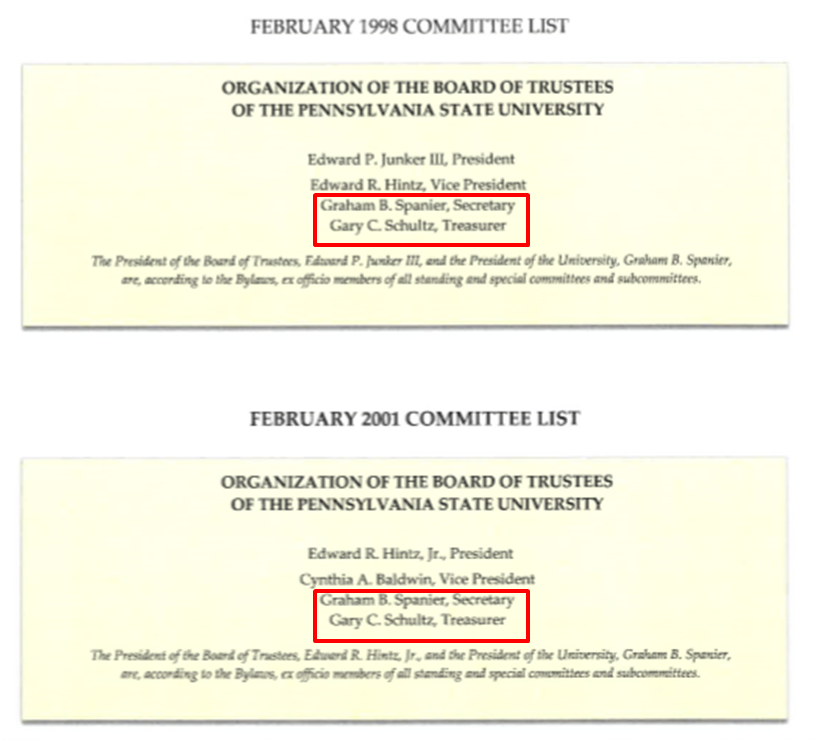
The charge of the football program concealing Sandusky activities from the Board of Trustees is also nonsense, given that Spanier and Schultz were members of the Board of Trustees (Freeh Report, Exhibit 10A).    


Emmert and NCAA officials ignored
the factual record in the Freeh Report
It truly boggles the mind that NCAA officials, such as Berst, Roe, and Emmert all stated that penalties should be levied from 1998 forward when the Freeh Report clearly showed PSU did everything correctly regarding the handling that incident.


This December 2012 exchange between Franco Harris and Mark Emmert reveals just how much  Emmert ignored the factual record in the Freeh Report.

Franco:  The report said in 1998 that Penn State was not involved in that.

Emmert: 
 Uh, uh, I read the report multiple times and I'm sure you have, and we'll have to agree to disagree.

Consent Decree Finding 2


The "plain language" in the Freeh Report (at 24) revealed that PSU Athletic Director Tim Curley instructed Sandusky not to use the facilities with children.  According to the trial verdicts in the case -- and the Freeh Report -- Sandusky did not use the facilities to commit crimes after 2001.


The "plain language" in the Freeh Report (at 36) also revealed that access to the University facilities for sports camps conducted by Sandusky and for the camps of The Second Mile were granted by PSU's Outreach and Cooperative Extension office -- not the Athletic Department.


Consent Decree Finding 3


Freeh Report Exhibit 6A proved that Spanier instructed PSU Counsel Baldwin to brief the Board regarding legal matters involved with the Sandusky investigation in April 2011.  That briefing was provided to the Board in May 2011, which was the first scheduled meeting after Spanier had been subpoenaed and testified in the Sandusky case.  Baldwin's briefing included information on the 1998, 2001, and the then-ongoing investigations of Sandusky.


As stated earlier, the 1998 investigation of Sandusky was handled in a confidential manner and resulted in no finding of abuse.  There was no reason for Spanier or anyone else to inform the Board about this incident as no one could have anticipated a legal action against PSU based on this isolated incident.


Similarly, the 2001 incident occurred when Sandusky was retired from PSU.  As a result, Sandusky's behavior was (at a minimum) reported to his employer (Freeh Report at 25).

Regardless of what Spanier or the Board did or didn't do, the Freeh Report (at 25) showed no  misconduct occurred within PSU's athletic facilities after 2001.  


No Rules Violations Reported In the Freeh Report

The Freeh Report provided no evidence of NCAA violations -- which are required to show that the alleged unethical and/or dishonesty of PSU officials resulted in a LOIC.  The Freeh Report mentions the NCAA just three times in the report at 37, at 38, and at 140, none of which address material deficiencies within the Athletic Department.

First, the report makes an unsupported claim that the Athletic Department's compliance function is understaffed.  Given that PSU had not had a major violation in its history (which the NCAA undoubtedly knew), what was the rationale for additional staffing?


The next reference to the NCAA in the Freeh Report (at 38) states that the University's independent auditing function  (Office of Internal Audit) conducted compliance audits with certain NCAA rules. Obviously, the OIA didn't find any rules violations according to the absence of findings in the Freeh Report.


The last mention of the NCAA in the Freeh Report (at 140) is within a "motherhood and apple pie" recommendation that PSU athletic department compliance officials and new hires should have a working knowledge of NCAA rules, among others. 


Remember, PSU paid Freeh $8.1 million for these types of recommendations and is currently paying George Mitchell about $1.8 million a year to monitor them.

This all begs the question, did anyone at the NCAA actually read the Freeh Report?

Who Really Read the Freeh Report?

It is quite likely that none of the key decision makers on the NCAA Executive Committee and Division I Board of Directors read more than the Executive Summary of the Freeh Report -- if that.  It may be just as likely that they didn't even do that.

Ed Ray's July 12th and 13th emails revealed that the reactions of the Head of the EC were based on media reports -- and not the Freeh Report.  On July 13th, he opined that "I think he has it right" with regard to Rick Reilly's ESPN article which also blamed PSU for the 1998 incident.  Note:  The op-ed by Reilly proved he was among those who didn't read the Freeh Report.


The July 13th email was written at 8:14 PM, which certainly gave Ed Ray time to read the Freeh Report.  However, I don't think Ed Ray spent one iota of time reading it, given his expectation that the NCAA was waiting for PSU's response to its November 17th letter.


The deposition of Bob Williams revealed he was reacting to Freeh's press conference comments and not the Freeh Report.   The word rape appears in the Freeh Report body just one time, on page 113, in a passage regarding the the crimes that fall under the Clery Act.  In addition, the Sandusky trial verdicts also revealed no incidents of rape on the PSU campus.    


David Berst's deposition revealed that he believed the Executive Committee were immediately voicing strong opinions on the matter based on details and was uncertain if they had read the Freeh Report or not.    


Conclusion

Ray: Head of the Executive Committee
or was he the Chief Rubber Stamper?
The lack of due diligence by the key decision makers at the NCAA -- to not make the effort to read the first 40 pages of the Freeh Report -- certainly gives one pause about their ability to be in any kind of leadership role.  Unfortunately, the NCAA EC is much like the "Old Guard" PSU BOT, which was referred to by many as the "country club."

It appears the EC was letting Mark Emmert and a small group run the show and they were simply a "rubber stamp" for that group's decisions.  

The facts of the case provides evidence that the NCAA Executives were the people guilty of violating (their own) NCAA rules by penalizing PSU and that the NCAA was the organization without adequate oversight -- not Penn State. 

Sunday, November 23

Media Wrong About Bluff, Death Penalty, and NCAA Influence

The preponderance of the evidence to date shows there was no death penalty ultimatum or bluff and that PSU was behind the narratives of the Freeh Report and the NCAA Consent Decree

By
Ray Blehar


Since November 10th, there has been a deluge of documents flooding the legal system.  The November 10th Corman v. NCAA filing alone was 325 pages. That was followed by more Corman filings on the 12th, 13th (2), and then a Paterno v. NCAA filing on  the 20th.

As in any case, the more information/evidence that is found, the clearer the picture gets.  

For those in the media who have not kept a close watch on the case, it was easy for them to (again) jump to conclusions based on a word or two in emails and a few other documents.

From their abbreviated review, the media concluded that PSU was bluffed into believing that the NCAA could sanction them.  They also jumped to the conclusion that the NCAA had influenced the Freeh Report  and that PSU came close to getting the death penalty.

Those stories are all wrong.


PSU influenced Freeh Report, not NCAA 

Nothing the NCAA briefed to the Freeh group about major violations or lack of institutional control was mentioned in the report.  In fact, the NCAA is only mentioned three times in the report and the best the Freeh report could muster was that the PSU compliance staff was understaffed.  This allegation, of course flies in the face of over a half century of results showing that PSU never had a major rules violation...and still doesn't.

The end notes of the Freeh Report reveal that it was mostly sourced from discussions with the PSU BOT members, Cynthia Baldwin, and the 1998 University Park police report.  The claims of being an exhaustive review are greatly exaggerated.  More was left out of the Freeh Report than was put in it.

Emails obtained by Ryan Bagwell and Bill Cluck revealed the "Core Group" who guided the construction of the report were PSU's Frazier, the PA government's Tomalis, FSS's Omar McNeil and Louis Freeh.  PSU BOT leaders, Karen Peetz and Keith Masser, were infrequent addressees on the emails.

Finally, the "culture" allegations lodged in the Freeh Report originated with the PSU Board and Erickson's Five Point Promise, specifically point number 1.


1.  I will reinforce to the entire Penn State community the moral imperative of doing the right thing - the first time, every time

-- We will revisit all standards, policies and programs to ensure they meet not only the law, but Penn State's standard. To oversee this effort, I will appoint an Ethics Officer that will report directly to me. 


-- I ask for the support of the entire Penn State community to work together to reorient our culture. Never again should anyone at Penn State feel scared to do the right thing. My door will always be open.


After Freeh proclaimed PSU's culture to be corrupt - based mostly on a dubious hearsay account of a crime allegedly witnessed by a demented janitor - PSU had Gene Marsh let the NCAA know that PSU agreed with the Freeh Report's assessment of Penn State's "culture" problem.


As Marsh would later explain in August 2012, the NCAA believed the so-called lack of institutional control was caused by the "culture," not a violation of NCAA rules.  He pointed to Article 2.1, which states the President or Chancellor has authority over athletics, as the primary reason for the sanctions.  However, an honest interpretation of the language reveals that the scope is compliance with NCAA rules and regulations, not ensuring coaches police the conduct of retired coaches or second guess the decisions of child welfare officials.


Principle of Institutional Control - NCAA Constitution Article 2.1.1
It is the responsibility of each member institution to control its intercollegiate athletics program in compliance with the rules and regulations of the NCAA. The institution's chief executive officer is responsible for the administration of all aspects of the athletics program, including approval of the budget and audit of all expenditures.

Winding back the clock to November 10th, 2011, Emmert in an ESPN interview stated that the NCAA would wait for the outcome of the criminal investigation before deciding how the NCAA would address the Penn State issue.  


The criminal cases against PSU officials were not concluded, however the NCAA decided to abandon their normal processes, citing the "unprecedented" nature of the case.

But the real reason the NCAA got involved was because: 1) Penn State wanted them to and 2)  coming down hard on PSU would boost the embattled organization's image.

As Marsh wrote above -- Erickson accepted the Freeh Report (on behalf of the Board) and then threw Spanier, Paterno, Curley, and Schultz and the "PSU culture" under the bus.  

The Board's  "goals," so to speak, were to get one more authority to confirm their decisions from 11/9/11 and to continue to assist the OAG in prosecuting PSU officials in the court of public opinion, if not in the eventual criminal trials.  

PSU was not "bluffed," communicated with NCAA all along

In January 2012, Erickson knew that the NCAA was informed of McQueary's gambling issues and some other potential minor rules violations.  

Evidence shows that both issues were uncovered during the criminal investigations relating to Sandusky, Curley, Schultz, and Spanier, given that Frank Fina advised PSU to not represent one of the possible criminal defendants allegedly related to the aforementioned issues. 

The NCAA rejected using this information in sanctioning PSU (i.e., no mention of them appear in the Consent Decree) because the information was obtained through the criminal justice system -- and not the so-called "independent" investigation by Freeh.

PSU Athletics:  "Fastidious on rules violations."
In the same time-frame, the NCAA also was told that the PSU Athletics Department compliance officials were "fastidious on rules violations (e.g., giving donations)."  The NCAA, likely realizing a case of Lack of Institutional Control (LOIC) couldn't be made on legitimately obtained evidence, responded that it would "wait for Freeh Report."   

Prior to the publication of the Freeh Report, emails were leaked to the press that resulted in reports that PSU officials were more concerned with the "humane" treatment of Sandusky, had no concern for victims, and that Graham Spanier may face charges in the case.  Not so ironically, PSU's comment on the email leaks/press reports was that "it would wait for the Freeh Report."

PSU, NCAA made case with media events
In short, PSU and the NCAA used every means at their disposal to dig up evidence that could be used to nail Paterno and PSU Athletics - but that evidence was hard to come by, even with Freeh using intimidation tactics on witnesses. 


Louis Freeh:  All show, no substance....
...and the media keeps falling for his act.
In the end, PSU and the NCAA were banking on Freeh's reputation and well crafted media events to overcome the lack of evidence in the case.  As history shows, the Freeh Report could not be delivered to the media in advance of his press conference due to a (planned) server crash.  The media simply ran with Freeh's press conference remarks without doing any fact-checking.

The quick acceptance of the report by Erickson, Frazier, and Peetz was astonishing to Penn Staters, who at this point, still believed that the PSU BOT was capable of rational thought and were somewhat honest people.  

However, the quick "approval" and the even quicker move to reach a settlement with the NCAA indicated that the two parties had prior knowledge of the flimsy evidence in the Freeh Report and were moving fast before the public learned the report was a sham.

It appears that by the morning of July 13th, PSU and the NCAA had been engaged in discussions and had formulated a plan among the top brass. That group likely included  Erickson, Tom Poole, and Frank Guadagnino for PSU and  Emmert, Remy, and Jim Isch for the NCAA.


In Erickson's interview on July 17th, he stated that Penn State would be responding to the four questions asked by the NCAA on November 17th,  2011 -- after which PSU would negotiate "appropriate sanctions."    

It's likely that this was one of the "bluffs" involved in this case, given that Erickson had already agreed to using the Freeh Report as the response to the questions and emails indicate the NCAA was already discussing sanctions.

The next passage will show that Erickson and high ranking PSU officials -- to include Gene Marsh -- lied about what transpired with the NCAA.  


Don Remy's email destroys myth of Death Penalty "Ultimatum"

The November 13th  Penn State filing in response to Corman's request for documents appears to hold the most important e-mail (Exhibit M) to date.  Correspondence of September 7, 2012,  between Don Remy and Gene Marsh revealed how the PSU/NCAA Consent Decree was developed.  Note that Remy stated the following italicized remarks are the statement he would make to the public, however the front end of his email to Marsh confirmed that the Death Penalty controversy resulted from Penn State's PR plan.


On July 10, 2012, the media disclosed that the Freeh Report would be issued and a
press conference would be held on July 12, 2012. I contacted the Penn State University Office of
General Counsel to inform them of the NCAA's position on this Report. Because Steve Dunham had
not yet taken office...

...on July 11, 2012, I spoke with acting general counsel Mark Faulkner and
others. I informed them that it would be the NCAA position when the Freeh Report was released that
we expected Penn State to respond to the November 17 letter and then the NCAA would determine
our course of action. That course of action could include anything from doing nothing to conducting a full blown enforcement investigation and going through the infractions process.

On that same day, July 11, 2012, President Emmert delivered a similar message to President Erickson. On July 12, 2012 the Freeh Report was issued and the NCAA released the message we had communicated to PSU: we expected a response and then we would see what was next. 

On July 12, 2012, you (Gene Marsh) contacted me for the first time and indicated that you would handle drafting the response for PSU, that you would be vacationing but would be available by mobile and we should try to connect the following week. We tried to connect over the weekend and...

...on Monday, July 15, 2012, you and I spoke and recognized that our clients (NCAA and Penn State) were contemplating the possibility of resolving matters without a response to the letter and without an enforcement investigation and infractions hearing, but rather through some summary resolution wherein Penn State would agree to the findings of the Freeh Report and the NCAA would impose a set of penalties based upon those findings.


Death Penalty: ..there's a chance...
On that same day, President Emmert appeared on a pre-scheduled interview with PBS where he discussed the Freeh Report and indicated that the NCAA was waiting for Penn State's response to his letter. In that interview he acknowledged that the traditional enforcement process was available and that all penalties, including the so-called death penalty were in play.

On July 17, 2012 the NCAA Executive Committee met and discussed the approach of a summary resolution based upon Penn State's adoption of the Freeh Report that would include various penalties. On that same day, David Berst and I communicated to you the proposed penalties and the approach of a binding consent decree. You will recall that the proposed fine was originally discussed to be $30 million and subsequently raised to $60 million and we initially neglected to report on the vacation of wins, but immediately followed up the call with an e-mail to that effect. President Emmert had a similar conversation with President Erickson.

Late night on July 20, 2012 you were sent a draft of the consent decree, pending NCAA Executive Committee approval. On July 21, 2012, the Executive Committee voted to approve the concepts of the penalties as they were spelled out in the final consent decree and that was communicated to you.

On July 23, the consent decree was executed and announced.

The Erickson video, as well as emails and drafts of the NCAA press release show that the penalties were changing as the process moved toward the 23rd.  

For example, the fine changed from $30 million to $60 million.  Emmert originally planned to rescind Paterno's 2010 Ford Foundation Award, but later relented.   

This was no take it or leave it, Death Penalty ultimatum -- it was just as Ed Ray truthfully reported.  

Ray's correspondence noted that the EC was overwhelmingly against suspension of play when it took its final (unanimous) vote on the penalties that would be enumerated in the NCAA Consent Decree.  The deposition of David Berst (page 221) revealed it was "understood by Gene (Marsh) that we might not ever get to the point where we could prove a case that would finally result in the death penalty."

So if Gene Marsh understood that the NCAA would have a difficult time justifying a case for the "death penalty," it would defy logic that he would get upset over Ed Ray's comments that the Death Penalty was quickly dispensed with by the NCAA Executive Committee.  

Of course, the reason he was upset was because Ed Ray's comments contradicted those of his client's (Penn State).


Collaboration on Public Relations

Based on the evidence above, the premise that the NCAA imposed the "unprecedented" process on PSU is clearly a lie. The vast majority of evidence to date supports the theory that it was a collaborative process.  

The Board also collaborated on the public statements that were devastating to the University, but amazingly kind to Karen Peetz and Rod Erickson.   

With regard to the latter, the PSU Executive Committee's (handwritten) meeting notes from 7/22/2012 reveal that "inner circle" requested Mark Emmert praise them, while throwing Paterno and others under the bus.


Emmert's press conference reveals he did a great job praising the Board and condemning Paterno (e.g., hero worship) and PSU athletics.  


As you read the preceding passage, I expect you were as dumbfounded (and quite possibly, as seething) as I was that the PSU Board and Erickson never spoke up to correct the record, even if just about academics.

There is no question that these individuals only cared for their own self-interest -- not the University's best interest.

Maintaining the Lies: The August 12, 2012 BOT Meeting

On August 12, 2012, the Board called a special meeting to discuss the process by which the NCAA imposed the consent decree and the sanctions on PSU and to affirm support of Rodney Erickson, whose authority to sign the CD was challenged by some trustees. 
  
As the discussion of the meeting turned to supporting Rod Erickson's decision to sign the CD, Peetz, Erickson, and Marsh all had their lies straight.


I absolutely support President Erickson and his  decision to accept the consent decree as the only real  option in the extraordinarily difficult circumstances  and the choices we were presented.  -- Karen Peetz


The next most substantive discussion was on Thursday evening (July 19th), and that message was loud and clear.   I was told that I should know that the majority of the  board of directors at the NCAA believe that the death  penalty should be imposed.  That was as late as Thursday evening and that's the first time that I heard, although I understand other places -- other    
numbers may have been tossed around, but that's the first time that I heard a multi-year death penalty. -- Gene Marsh


 Our legal team then began discussions with  NCAA legal counsel on Monday, July 16th, and it was clear that the NCAA was not interested in negotiating  the terms of the consent decree.  It was a take it or  leave it proposition, and despite our attempts to push  back on the sanctions as we learned about them we  didn't, as Gene indicates, receive the draft consent  decree in writing until the early hours of Saturday  morning then.  -- Rodney Erickson

Erickson's August 12th  statement contradicted his remarks on July 17th, which clearly were that PSU would be negotiating the sanctions.  As much of the evidence above shows, Erickson is guilty of lies of omission about quite a few things in this case -- some things could be considered an obstruction of justice.

Marsh, who had considerable experience with the NCAA, knew that the option to go the traditional enforcement route was available and his discussions with Remy and Berst revealed that he knew the NCAA would be hard pressed to make a case for the death penalty. 

His remarks to the Board about Article 2.1 being the "law of the land" for LOIC in this case were indeed a lie.


Peetz:  No mastermind.
As for Karen Peetz, she was not the mastermind behind any of this, but was willing to assist with the PR campaign to make her "leadership" of the BOT look good, while smearing Paterno and the football program.  

Peetz, who played field hockey at PSU, held a grudge against the football program, which unbeknownst to her, funded her own sport.  

Obviously, Karen is just as brilliant now as she was then.

Conclusion

As more evidence has come out, proper interpretation of the information reveals that select members of the PSU Board of Trustees, such as Erickson, Frazier, Tomalis, Peetz, and Surma, as well as key members of the PSU legal team, were firmly supporting the OAG's narrative that Paterno and key members of the administration had covered up Sandusky's crimes.

They hoped that the NCAA Consent Decree, with provisions stating that PSU could not challenge or appeal it through the NCAA's process or a judicial process would convince Penn Staters and supporters that it (and the Freeh Report) was the final word -- and the only solution was to "move forward."

They failed.