
By
Ray Blehar
Over the past month, the media has quickly jumped on a few words or a passage from a deposition to draw conclusions about the NCAA's role in punishing PSU. In most cases, the conclusions drawn have been incorrect, including the conclusion that PSU was bluffed by the NCAA and a later piece citing Rod Erickson's "out for blood" statements as proof that PSU was under duress.
However, when reading and digesting all of the information available to date, the thing that sticks out most is that the "plain language" of the documents from this case defeat the "stories" being put forth by the defendants (and others, like former AG Linda Kelly).
Prior to the recent filings, the NCAA and PSU were both attempting to defend the legality/validity of the NCAA Consent Decree (CD). As the Corman case has progressed, the co-defendants now have somewhat opposite agendas which must be considered when evaluating the truthfulness of their statements.
PSU Agenda: Maintain duress scenario, Erickson's authority
PSU's agenda is to maintain the story that it signed the CD under threat of the death penalty, that Erickson had authority to sign for PSU, and that Erickson did the best that it could in light of the NCAA "being out for blood." However, the depositions of Guadagnino and Erickson contained numerous inconsistencies and outright falsehoods that undermined their stories.Guadagnino (at 19) stated that he was hired as counsel for the Board in November 2011 -- which should give anyone pause about his qualifications -- considering the failure of all the lawyers involved to push back against the baseless charges against Curley and Schultz.
He also stated (at 50) that in July, he and Dunham, with help from Paula Ammerman (!), determined the President of PSU had the authority to sign the consent decree because nothing in PSU's rules prohibited him from doing so. Erickson (at 125) also made that statement. Those statements were patently false based on the "plain language" of the PSU BOT Standing Orders that were in effect in July 2012.
Order IV. MATTERS REQUIRING APPROVAL OF THE BOARD OF TRUSTEES, 2. e.
"(e) Authorization to borrow money; authorization of persons to sign checks,contracts, legal documents, and other obligations, and to endorse, sell,or assign securities."
 |
| Guadagnino and Dunham: Legal advice on Erickson's authority influenced by Frazier? |
The question in my mind is how did the TWO lawyers come to the conclusion that Erickson had the authority to sign the Consent Decree? My guess is they were told to come to that conclusion by former Merck Counsel and SITF co-lead Ken Frazier.
The NCAA's agenda: Maintain it was authorized to punish PSU
 |
| Erickson's "guilty plea" of LOIC was all the NCAA had to go on. |
The deposition of Don Remy shows this most clearly, when he was asked if the NCAA accepted the Freeh Report. He responded that they did not need to -- because Penn State did. Really, what Erickson did in one fell swoop was to accept the Freeh Report and, most importantly, state to the NCAA the Freeh Report contained the evidence to support a Lack of Institutional Control (LOIC).
The "plain language" of its Constitution and By-Laws required violations of "applicable rules and regulations of the Association in the conduct of its intercollegiate athletics programs" for LOIC. The NCAA knew there was no case -- and so did PSU.
Regardless of Erickson's admissions and willingness to enter into an agreement, the NCAA had no authority to uphold PSU's "guilty plea" of LOIC or to penalize PSU. The situation is analogous to a judge knowing that no crime was committed but accepting a guilty plea by the defendants' "attorney" (Erickson) -- all the while knowing the defendants (i.e. Curley and Schultz) were innocent.
Moreover, the NCAA's Julie Roe stated that it was doubtful that the penalties could have survived the enforcement (Committee on Infractions) process. As I wrote here, even if the premature conclusion that there were ethical issues among the President, Head Coach, and/or Athletic Director at PSU, there were no NCAA rules violations resulting from the lack of ethics. To make another analogy, if Spanier, Paterno, and Curley all turned out to be tax cheats, would the NCAA be authorized to punish the football program based on their dishonesty? The answer is obviously, "no."
Those, like David Berst, who made the argument that their alleged lack of ethics/dishonesty enabled 14 years of despicable crimes being committed by Sandusky would, ironically, be proven wrong by the "plain language" of the Freeh Report.
Irony: "Plain Language" of Freeh Report Disproved LOIC
In the greatest irony in this case, the validity of three Freeh Report key findings cited in the CD were actually undermined by the contents of the Freeh Report. In an equally interesting twist, no one had to do more than read to page 40 and leaf through the Exhibits to find the evidence that obliterated the so-called "factual basis" for the sanctions.These facts likely explain why there was such a rush by PSU to create a smokescreen of about the quality of the Freeh Report in an attempt to legitimize its findings.
Frazier: “We thank Judge Freeh for his diligence in uncovering the facts over the past eight months and issuing such a comprehensive and thorough report.."
While the report was neither complete nor thorough, it had enough in it to disprove the key findings in its own Executive Summary, which were quoted in the CD.
Consent Decree Finding 1

Pages 20-30 of the Freeh Report specify crimes between 1998 and 2001, a span of four years -- not a decade. No other crimes occurred on campus after 2001, according to the "plain language" of the Freeh Report (at 24 and 25).

Next, there was no concealment of Sandusky's behaviors in 1998 nor in 2001.
Freeh Report (at 20) clearly shows that the head of the University Park police department, a police detective, child welfare caseworker, and the local district attorney were all engaged on the case in 1998.

It is important to note that Sandusky was a full-time assistant coach with the football team during this fully reported and investigated incident in 1998. The NCAA's assertion that the football program was unanswerable to oversight was nonsense.
In 2001, when Sandusky was a retired football coach, the Freeh Report (at 23) proved that head football coach Joe Paterno and graduate assistant coach, Mike McQueary, promptly reported Sandusky's activities to those in positions of power both inside (Curley) and outside (Schultz) the Athletic Department. Additionally, Schultz sought legal advice on the matter from PSU's outside counsel Wendell Courtney.

Next, there was no concealment of Sandusky's behaviors in 1998 nor in 2001.
Freeh Report (at 20) clearly shows that the head of the University Park police department, a police detective, child welfare caseworker, and the local district attorney were all engaged on the case in 1998.
It is important to note that Sandusky was a full-time assistant coach with the football team during this fully reported and investigated incident in 1998. The NCAA's assertion that the football program was unanswerable to oversight was nonsense.
In 2001, when Sandusky was a retired football coach, the Freeh Report (at 23) proved that head football coach Joe Paterno and graduate assistant coach, Mike McQueary, promptly reported Sandusky's activities to those in positions of power both inside (Curley) and outside (Schultz) the Athletic Department. Additionally, Schultz sought legal advice on the matter from PSU's outside counsel Wendell Courtney.
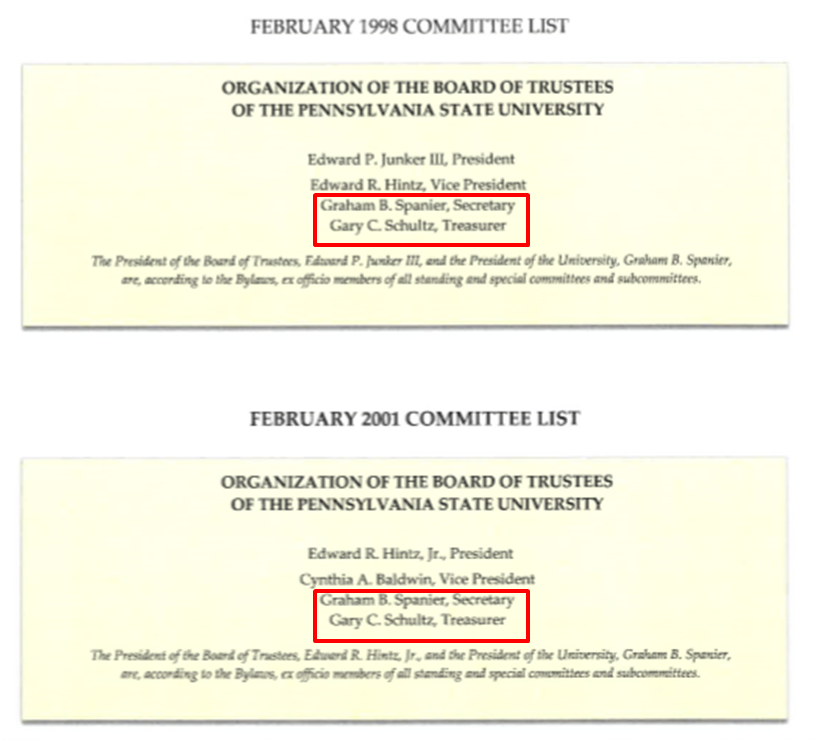
The charge of the football program concealing Sandusky activities from the Board of Trustees is also nonsense, given that Spanier and Schultz were members of the Board of Trustees (Freeh Report, Exhibit 10A).
 |
| Emmert and NCAA officials ignored the factual record in the Freeh Report |
It truly boggles the mind that NCAA officials, such as Berst, Roe, and Emmert all stated that penalties should be levied from 1998 forward when the Freeh Report clearly showed PSU did everything correctly regarding the handling that incident.
This December 2012 exchange between Franco Harris and Mark Emmert reveals just how much Emmert ignored the factual record in the Freeh Report.
Franco: The report said in 1998 that Penn State was not involved in that.
Emmert: Uh, uh, I read the report multiple times and I'm sure you have, and we'll have to agree to disagree.
Emmert: Uh, uh, I read the report multiple times and I'm sure you have, and we'll have to agree to disagree.
Consent Decree Finding 2

The "plain language" in the Freeh Report (at 24) revealed that PSU Athletic Director Tim Curley instructed Sandusky not to use the facilities with children. According to the trial verdicts in the case -- and the Freeh Report -- Sandusky did not use the facilities to commit crimes after 2001.

The "plain language" in the Freeh Report (at 36) also revealed that access to the University facilities for sports camps conducted by Sandusky and for the camps of The Second Mile were granted by PSU's Outreach and Cooperative Extension office -- not the Athletic Department.

Consent Decree Finding 3

Freeh Report Exhibit 6A proved that Spanier instructed PSU Counsel Baldwin to brief the Board regarding legal matters involved with the Sandusky investigation in April 2011. That briefing was provided to the Board in May 2011, which was the first scheduled meeting after Spanier had been subpoenaed and testified in the Sandusky case. Baldwin's briefing included information on the 1998, 2001, and the then-ongoing investigations of Sandusky.


As stated earlier, the 1998 investigation of Sandusky was handled in a confidential manner and resulted in no finding of abuse. There was no reason for Spanier or anyone else to inform the Board about this incident as no one could have anticipated a legal action against PSU based on this isolated incident.
Similarly, the 2001 incident occurred when Sandusky was retired from PSU. As a result, Sandusky's behavior was (at a minimum) reported to his employer (Freeh Report at 25).
Regardless of what Spanier or the Board did or didn't do, the Freeh Report (at 25) showed no misconduct occurred within PSU's athletic facilities after 2001.
No Rules Violations Reported In the Freeh Report
The Freeh Report provided no evidence of NCAA violations -- which are required to show that the alleged unethical and/or dishonesty of PSU officials resulted in a LOIC. The Freeh Report mentions the NCAA just three times in the report at 37, at 38, and at 140, none of which address material deficiencies within the Athletic Department.First, the report makes an unsupported claim that the Athletic Department's compliance function is understaffed. Given that PSU had not had a major violation in its history (which the NCAA undoubtedly knew), what was the rationale for additional staffing?


The last mention of the NCAA in the Freeh Report (at 140) is within a "motherhood and apple pie" recommendation that PSU athletic department compliance officials and new hires should have a working knowledge of NCAA rules, among others.

Remember, PSU paid Freeh $8.1 million for these types of recommendations and is currently paying George Mitchell about $1.8 million a year to monitor them.
This all begs the question, did anyone at the NCAA actually read the Freeh Report?
Who Really Read the Freeh Report?
It is quite likely that none of the key decision makers on the NCAA Executive Committee and Division I Board of Directors read more than the Executive Summary of the Freeh Report -- if that. It may be just as likely that they didn't even do that.Ed Ray's July 12th and 13th emails revealed that the reactions of the Head of the EC were based on media reports -- and not the Freeh Report. On July 13th, he opined that "I think he has it right" with regard to Rick Reilly's ESPN article which also blamed PSU for the 1998 incident. Note: The op-ed by Reilly proved he was among those who didn't read the Freeh Report.

The July 13th email was written at 8:14 PM, which certainly gave Ed Ray time to read the Freeh Report. However, I don't think Ed Ray spent one iota of time reading it, given his expectation that the NCAA was waiting for PSU's response to its November 17th letter.

The deposition of Bob Williams revealed he was reacting to Freeh's press conference comments and not the Freeh Report. The word rape appears in the Freeh Report body just one time, on page 113, in a passage regarding the the crimes that fall under the Clery Act. In addition, the Sandusky trial verdicts also revealed no incidents of rape on the PSU campus.

David Berst's deposition revealed that he believed the Executive Committee were immediately voicing strong opinions on the matter based on details and was uncertain if they had read the Freeh Report or not.

Conclusion
 |
| Ray: Head of the Executive Committee or was he the Chief Rubber Stamper? |
It appears the EC was letting Mark Emmert and a small group run the show and they were simply a "rubber stamp" for that group's decisions.
The facts of the case provides evidence that the NCAA Executives were the people guilty of violating (their own) NCAA rules by penalizing PSU and that the NCAA was the organization without adequate oversight -- not Penn State.


