
By
Ray Blehar
Penn State President Eric Barron responded to the latest media attacks on the University by issuing a statement chastising them for rushing to judgment and publishing sensationalized stories.
The most important passages of his statement bear repeating (my emphasis added):
"....over the last two days we have worked to be diligent in reanalyzing the record of reports and depositions to ensure that our reactions and comments are both responsible and trustworthy.
First, the allegations related to Penn State are simply not established fact. The two allegations related to knowledge by Coach Paterno are unsubstantiated and unsupported by any evidence other than a claim by an alleged victim. They date from the 1970s. Coach Paterno is not alive to refute them. His family has denied them.
Second, we cannot find any evidence, related to a settlement or otherwise, that an alleged early assault was communicated to Coach Paterno. This raises considerable credibility issues as to this press report. Others cite assistant coaches that were witnesses or had knowledge – stating it as fact in headlines and text – even in the face of a denial and clear failure to corroborate from the individuals allegedly involved. Other stories are clearly incredulous, and should be difficult for any reasonable person to believe. We should not be rendering judgments about the actions of Coach Paterno or any other former employees of Penn State based on incomplete, sensationalized media accounts.
While Barron did not get into the details, his description that these accounts are "incredulous" and "difficult for any reasonable person to believe" were 100 percent accurate. That two national media outlets like CNN and NBC would allow these stories to be run demonstrates how far both individual and organizational ethics have fallen.
Yellow Journalism by Sara Ganim, CNN
Sara Ganim’s column regarding an alleged 1971 child sex
abuse incident that was allegedly reported to Joe Paterno
should serve as reminder of why she won a Pulitzer Prize for LOCAL (not investigative) about
the “Penn State Scandal.”
Ganim covered scandal over a year and knew that Sandusky was an
acquaintance offender who befriended pre-teen boys and groomed them for
victimization. In the latest article, she mentions victims being hesitant to come forward as a result of their "close relationships" with Sandusky. As such, she obviously knew that her story
of Sandusky picking up a 15 year old hitchhiker, plying him with drugs and
alcohol, and forcibly raping him was not consistent with Sandusky’s modus
operandi.
The story continued on its incredulous path by then stating when the foster parents of the youth (dubbed Victim A) found out, they directed him to call high-ranking Penn State officials -- then told the youth that Penn State wouldn't call the police.
If these foster parents understood that, why didn't they call the police themselves?
"So many good things"
In what is surely a fabrication, the alleged Victim A states that he called the University and took part in a conference call with Joe Paterno and a man named Jim.
After allegedly telling them he was raped by Sandusky, he alleged Paterno and Jim threatened to call the authorities on him because they couldn't believe an attack could have come from a man who "did so many good things."
The year was 1971 and Sandusky had joined the coaching staff in 1969. He was an unheralded position coach then, and most importantly, would form his Second Mile charity six years later (in 1977).
In short, Sandusky wasn't famous in the community for his charitable work in 1971.
This adds more evidence of a fabricated story.
This adds more evidence of a fabricated story.
Unreliable Source
However, Ganim attempted to bolster this ridiculous story by using well known Paterno-hater, Bernie McCue, as the corroborating source.
She had to know her corroborating witness would not be viewed as an unbiased/credible source, as he was featured in the movie Happy Valley conducting a pathetic one-man protest at the Paterno statue.

McCue also had other anti-Paterno actions in his past, including writing derogatory and offensive notes in the courtesy newspapers and magazines provided at the Corner Room, then returning them for other patrons to find.
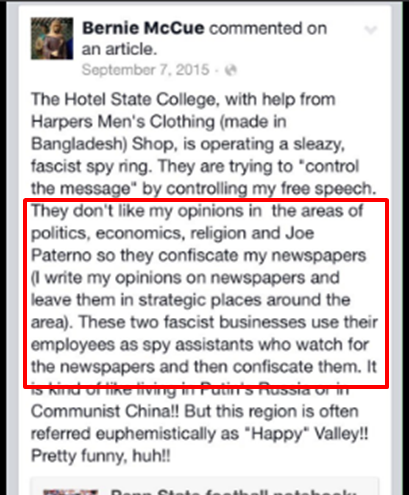
He was also arrested for harassment regarding an incident allegedly over Peachy Paterno ice cream being served at the Berkey Creamery.

He was also arrested for harassment regarding an incident allegedly over Peachy Paterno ice cream being served at the Berkey Creamery.
According to source McCue, the alleged victim told him about the abuse in 1972. McCue was 33 or 34 years old when he got the report from the 15-16 year old victim. How did McCue explain coming in contact with the victim? Ganim doesn't say.
More than likely, she didn't think to check those facts and ask the question. However, it does raise an interesting question about McCue and his motivations.
As the old saying goes, "the guilty dog barks the loudest."
As the old saying goes, "the guilty dog barks the loudest."
In summary, no investigative reporter would ever use a questionable source like Bernie McCue, which is consistent with the fact that Ganim is NOT an investigative reporter.
While Ganim's incompetence is evident, how was it that the editors at CNN weren't asking these questions about her incredulous story?
The only credible part of Ganim's story came at the end, where a state trooper recalled thinking the story was "too crazy to be believed."
Yellow Journalism by NBC
On May 8th, an NBC story, citing mostly unnamed sources, stated unequivocally that as many as six Penn State coaches had witnessed Sandusky's "inappropriate behavior" with children.
In fact, the article later stated that none of these incidents were corroborated, as a lawyer for one coach refuted the allegation, one coach refused to comment, one couldn't be reached, and the other is unknown.
NBC then referenced a report by Sandusky's adopted son, Matthew, that he was informed that a coach saw him being molested by Sandusky in a PSU locker room.
In Matthew Sandusky's recently released book, Undaunted, he told the story of how Jerry Sandusky was able to hide in plain sight and abuse children while in the presence of other, unwitting adults.
On page 10, Matthew specifically recalled a "wrestling" incident in which he was being fondled, but Sandusky stopped the fondling when he heard the door's cipher code being pressed, alerting them to someone entering the room. According to Matthew's account, Jerry then asked the assistant coach who walked in to do a three count as Jerry pretended to "pin" Matthew.
Numerous victims at the trial mentioned Sandusky wrestling with them as part of their "workouts."
Those familiar with the case also know that Victim 4 also mentioned the cipher code noise being used as a signal by Sandusky to disengage in whatever inappropriate conduct that was ongoing.
Sex crimes expert James Clemente also noted that, in his experience, many serial child molesters were experts in utilizing abuse techniques that provided them with plausible deniability. According to trial testimony, Sandusky used techniques such wrestling matches, tickling, blowing raspberries on the boy's stomachs as a means of accomplishing this.
All of the information above is readily available on the public record. NBC knew or should have known that Sandusky was able to avoid detection even when abusing boys in plain sight. As such, the coaches observing Sandusky and the child likely had no idea anything "inappropriate" was occurring.
Finally, it bears repeating that none of these claims were corroborated by the coaches who were alleged to have observed "inappropriate behavior" and that Penn State issued a statement that there is no evidence supporting the claims.
Clicks
Yellow Journalism by NBC
On May 8th, an NBC story, citing mostly unnamed sources, stated unequivocally that as many as six Penn State coaches had witnessed Sandusky's "inappropriate behavior" with children.
In fact, the article later stated that none of these incidents were corroborated, as a lawyer for one coach refuted the allegation, one coach refused to comment, one couldn't be reached, and the other is unknown.
NBC then referenced a report by Sandusky's adopted son, Matthew, that he was informed that a coach saw him being molested by Sandusky in a PSU locker room.
In Matthew Sandusky's recently released book, Undaunted, he told the story of how Jerry Sandusky was able to hide in plain sight and abuse children while in the presence of other, unwitting adults.
On page 10, Matthew specifically recalled a "wrestling" incident in which he was being fondled, but Sandusky stopped the fondling when he heard the door's cipher code being pressed, alerting them to someone entering the room. According to Matthew's account, Jerry then asked the assistant coach who walked in to do a three count as Jerry pretended to "pin" Matthew.
Numerous victims at the trial mentioned Sandusky wrestling with them as part of their "workouts."
Those familiar with the case also know that Victim 4 also mentioned the cipher code noise being used as a signal by Sandusky to disengage in whatever inappropriate conduct that was ongoing.
Sex crimes expert James Clemente also noted that, in his experience, many serial child molesters were experts in utilizing abuse techniques that provided them with plausible deniability. According to trial testimony, Sandusky used techniques such wrestling matches, tickling, blowing raspberries on the boy's stomachs as a means of accomplishing this.
All of the information above is readily available on the public record. NBC knew or should have known that Sandusky was able to avoid detection even when abusing boys in plain sight. As such, the coaches observing Sandusky and the child likely had no idea anything "inappropriate" was occurring.
Finally, it bears repeating that none of these claims were corroborated by the coaches who were alleged to have observed "inappropriate behavior" and that Penn State issued a statement that there is no evidence supporting the claims.
Clicks
The bottom line is that CNN and NBC weren't interested in accuracy and had stories that were "too good to check." As Jay Paterno wrote, they are part of a media who is only interested in "clicks."


